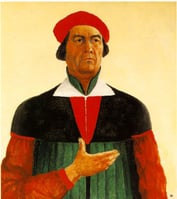
Kazimir Malevich の Devils Sawing a Sinner の専門的な分析
スタイル:Naïve Art (Primitivism) · ジャンル:poster
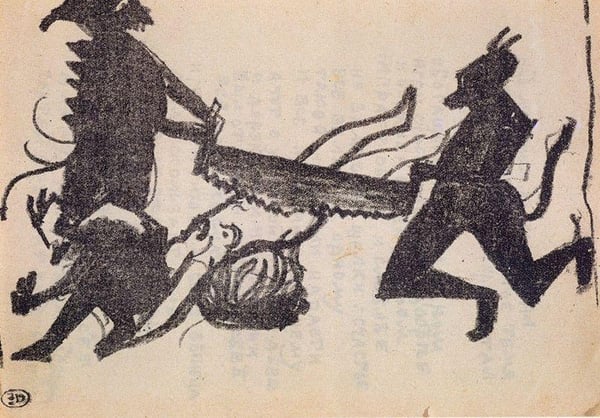
Expert Analysis: "Devils Sawing a Sinner" by Kazimir Malevich
Style & Period Context:
As a poster executed in the Naïve Art (Primitivism) style, this work represents a crucial phase in Malevich’s early career, before his radical shift toward Suprematism. Primitivism in early 20th-century Russian art drew heavily from folk traditions, peasant iconography, and lubok (popular woodcut prints). Malevich, alongside artists like Natalia Goncharova and Mikhail Larionov, used this “crude” visual language to break away from academic naturalism and Western illusionism, embracing flat, unmodulated colors, distorted perspective, and deliberately childlike or “uncouth” forms.
Significance Within the Style:
“Devils Sawing a Sinner” exemplifies the political and social edge of Russian Primitivism. The scene—a grotesque depiction of demons torturing a damned soul—is rooted in medieval Russian iconography and folk morality tales. However, Malevich transforms this religious warning into a satirical, anti-clerical, and possibly anti-tsarist statement. The poster format itself (mass-produced, intended for public display) aligns with the avant-garde’s desire to reach a broad, often illiterate audience, using stark, memorable imagery over textual narrative.
Formal Analysis:
The composition relies on stark contrasts: black outlines, earthy reds, and flat areas of color, echoing the woodcut tradition. Figures are simplified to near-abstract symbols—devils with angular limbs and skeletal faces, the sinner rendered as a passive, horizontal mass. The saw, a phallic tool of punishment, is emphasized through repetitive diagonal lines, creating a rhythmic, almost mechanical torture. There is no depth or shading; the picture plane remains aggressively flat, forcing viewers to confront the raw, folkloric horror directly.
Historical & Artistic Importance:
This work marks a bridge between Malevich’s earlier peasant-cycle paintings (like The Woodcutter) and his later geometrically abstract experiments. It demonstrates how Primitivism allowed Malevich to strip art down to its essential emotive and symbolic core—a step that ultimately led him to reject figurative representation altogether. Moreover, the poster’s blend of naivety and visceral violence reflects the turbulent pre-Revolutionary period, when traditional authority (church, state) was increasingly mocked through crude, vernacular satire.
Conclusion:
“Devils Sawing a Sinner” is significant not merely as an early Malevich curiosity, but as a key example of how Russian Primitivism weaponized “low” art forms to critique and dismantle older cultural hierarchies. It foreshadows the artist’s lifelong pursuit of radical simplification—here, of narrative, form, and moral stance—while grounding his avant-garde innovations in the soil of folk memory.
ジャンル
視覚的に類似
構図やパレットが近い作品 20 件
Untitled
Kinder Album
Tuning saws
Oleksandr Bogomazov
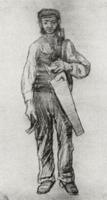
Carpenter
Vincent van Gogh
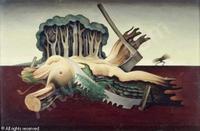
Femme surréaliste
Félix Del Marle
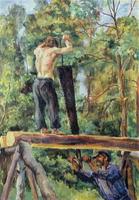
Sawyers
Pyotr Konchalovsky
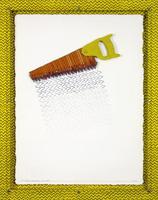
Graffiti III
Barton Lidice Benes
The Sleeper
Andre Masson
Workshop (Builders #1)
Jacob Lawrence
The Wood Sawyer
Frederick McCubbin
Tools for Change
Harriet Bart
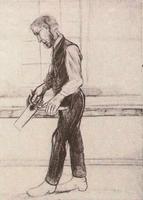
Man with Saw
Vincent van Gogh
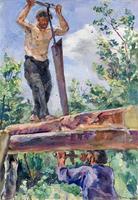
Sawyers
Pyotr Konchalovsky
11. Building the Log Cabin
Francis Davis Millet
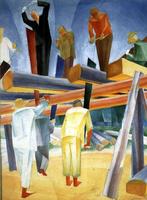
Sawyers
Oleksandr Bogomazov
Kondor Béla, William
Kondor Béla
Midwest
Thomas Hart Benton
Sawing Timber
Frederick McCubbin
Discrimination Of Thyself
Paul F. Yount
Bush Sawyers
Frederick McCubbin
Aviator
Kazimir Malevich