
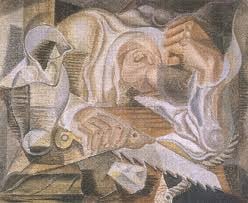
Expertenanalyse zu Andre Massons The Sleeper
Stil: Cubism · Genre: genre painting
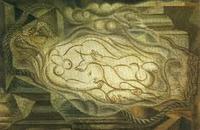
As an expert art historian, I will analyze "The Sleeper" by André Masson based solely on the structured facts provided: its classification as a Cubist work within the genre painting tradition. This combination is significant because it represents a convergence of two distinct artistic impulses—Cubism's radical formal analysis and genre painting's intimate, everyday subject matter.
Significance within Cubism:
Masson’s The Sleeper is a noteworthy example of how Cubist principles could be applied to a traditionally domestic, narrative-free subject: a figure at rest. Most canonical Cubist works (by Picasso and Braque) focused on still lifes, portraits, or musical instruments—subjects that allowed for systematic deconstruction of form. Here, Masson adapts the Cubist vocabulary of fractured planes, interlocking geometric facets, and ambiguous spatial depth to a genre scene. The sleeping figure is not rendered as a naturalistic body but as a constellation of angular, overlapping shapes that dissolve the boundary between figure and ground. This approach emphasizes the painting’s status as a constructed object rather than a window onto reality, a core tenet of Cubism. The work thus extends Cubism’s reach into the realm of private, quiet observation, proving that even a passive, slumbering subject could be reinvigorated through formal fragmentation.
Significance within Genre Painting:
As a genre painting—depicting an everyday, non-heroic scene—The Sleeper challenges the traditional expectations of that category. Genre painting historically aimed for naturalistic, often sentimental portrayals of daily life (e.g., Dutch Golden Age interiors). Masson’s Cubist treatment strips away any narrative or emotional sentiment, replacing it with a purely visual investigation. The sleeper is anonymized and de-individualized; the painting’s power lies not in who sleeps or why, but in how the act of sleeping is translated into a puzzle of shifting perspectives and flattened volumes. This radical reinterpretation marks a departure from conventional genre painting, making the work a bridge between early modernism and the subjective distortions of Surrealism (Masson’s later style). It demonstrates that even the most mundane subject can become a vehicle for avant-garde experimentation.
Overall Significance:
The Sleeper is significant because it proves that Cubism was not confined to heroic or intellectual subjects; it could suffuse the most private, passive moments of human experience with formal complexity. By situating a genre painting within the Cubist framework, Masson expands the stylistic boundaries of both movements, offering a quiet but radical statement: the very act of sleeping is a fertile ground for the deconstruction of vision.
Genre
Stil
Visuell ähnlich
20 Werke mit ähnlicher Komposition und Farbpalette
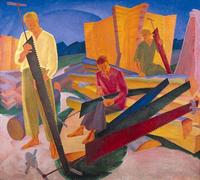
Tuning saws
Oleksandr Bogomazov
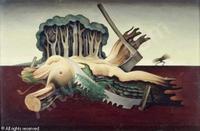
Femme surréaliste
Félix Del Marle
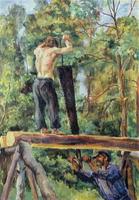
Sawyers
Pyotr Konchalovsky
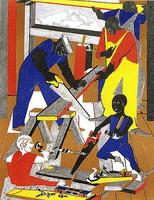
Workshop (Builders #1)
Jacob Lawrence
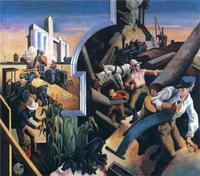
Midwest
Thomas Hart Benton
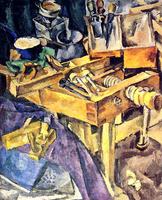
Workbench
Pyotr Konchalovsky

Devils Sawing a Sinner
Kazimir Malevich
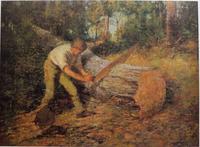
The Wood Sawyer
Frederick McCubbin
Untitled
Kinder Album
Sawyers
Oleksandr Bogomazov
Carpenter
Vincent van Gogh
Two naked
Andre Masson
Workmen In The House
Stanley Spencer
Saint Sergius' labours (central part of the triptych)
Mikhail Nesterov
Joiner's Workshop
Gustav Wentzel
Sawyers
Pyotr Konchalovsky

Sawing Timber
Frederick McCubbin
Christ in the House of His Parents
John Everett Millais

11. Building the Log Cabin
Francis Davis Millet

Bush Sawyers
Frederick McCubbin