Expertenanalyse zu Kazimir Malevichs Landscape with White House
Stil: Neo-Suprematism · Genre: cityscape
Expert Analysis: "Landscape with White House" by Kazimir Malevich
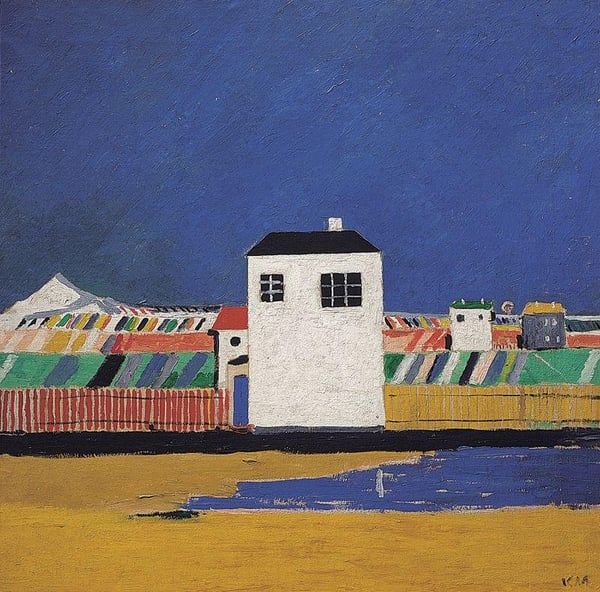
Kazimir Malevich’s Landscape with White House stands as a revealing bridge between the radical abstraction of his early Suprematism and a later, more figurative phase often termed Neo-Suprematism. While the painting retains the genre of a cityscape, it does not offer a conventional representation of an urban scene. Instead, Malevich reinterprets architectural and natural forms through the lens of his pioneering geometric vocabulary.
Significance within Neo-Suprematism:
-
Post-Abstraction Synthesis: After his iconic Black Square (1915) and purely non-objective works, Malevich began reintroducing recognizable objects—here a house, trees, and a sky—but stripped them of illusionistic depth. The white house is rendered as a flat, clean planar shape, while the surrounding landscape is reduced to simplified color blocks (greens, blues, and earth tones) that float in an ambiguous, non-perspectival space.
-
Suprematist Geometry in a Figurative Context: The composition is governed by the same dynamic tensions found in Malevich’s earlier abstract work: diagonals, floating rectangles, and a sense of weightless balance. The house does not sit solidly on a ground line; it hovers, almost as if it were one of Malevich’s geometric elements in a state of cosmic suspension. This transforms a mundane suburban motif into a meditation on the essential forms of perception.
-
Color as Pure Sensation: Malevich uses color not to describe local hues but to evoke emotional and spatial “sensations.” The white of the house, set against the deep blue sky and warm greens, creates a stark, almost spiritual focal point. This aligns with Suprematist theory, where color and form alone convey meaning, independent of narrative.
Why It Matters: Landscape with White House demonstrates that Malevich never abandoned his Suprematist ideals; he adapted them. It is a crucial document of his artistic evolution, showing his attempt to reconcile pure abstraction with the visible world, a direction that influenced later geometric abstraction and Constructivist architecture. In this work, the cityscape becomes a laboratory for reducing reality to its elemental, metaphysical geometry—a hallmark of Neo-Suprematism’s search for a universal visual language.
Genre
Stil
Visuell ähnlich
20 Werke mit ähnlicher Komposition und Farbpalette
Předměstské zahradnictví
Josef Capek
The unmade road
John Brack
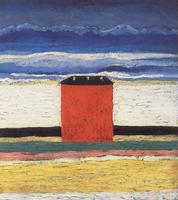
Red House
Kazimir Malevich
Factory
Toyen
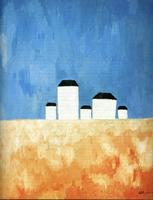
Landscape with Five Houses
Kazimir Malevich
Case la mare
Ion Pacea
Rockport
Maurice Prendergast
Untitled
Constantin Blendea
Houses and Street
O. Louis Guglielmi
White Buildings
Jack Bush
Santa Panagia (Sicily)
Renato Guttuso
Sketch for stage set, Glinka's King Life
Vladimir Tatlin
Pineapple Plantation
Dorrit Black
Landscape
Jean Metzinger
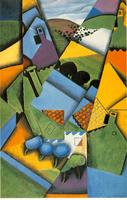
Landscape with House at Ceret
Juan Gris
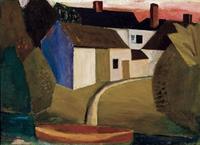
View of a village with a boat
Gustave de Smet
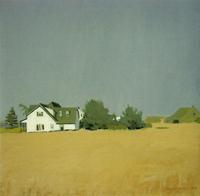
Wheat
Fairfield Porter
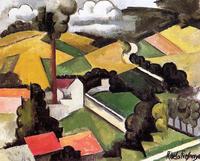
The Factory Chimney, Meulan Landscape
Roger de La Fresnaye
Anna Margit, Nyár 1962
Anna Margit
Le Chemin a travers les champs
Jean Metzinger