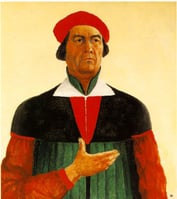
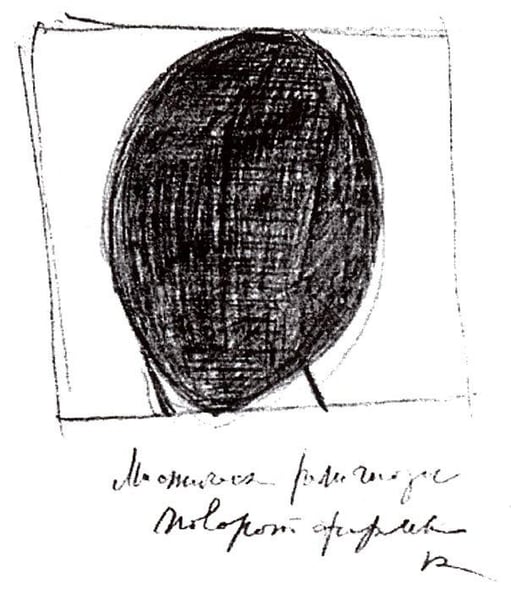
Mystical religious rotation of shape
Analisi esperta di Mystical religious rotation of shape di Kazimir Malevich
Stile: Neo-Suprematism · Genere: sketch and study
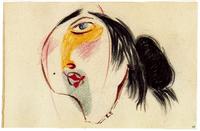
As an art historian, I can provide an analysis based on the given facts. The work in question is “Mystical religious rotation of shape” by Kazimir Malevich, classified under Neo-Suprematism and as a sketch and study.
Significance within the Neo-Suprematist Context:
While Malevich founded Suprematism in 1915 with works like Black Square, the label “Neo-Suprematism” suggests a later, perhaps more esoteric or synthetic phase of his career. This sketch is significant because it directly bridges Malevich’s radical geometric abstraction with a mystical, spiritual dimension—a core but often overlooked thread in his theory.
The title itself is revelatory: Mystical religious rotation of shape. In classical Suprematism, geometric forms floated in a white void, representing pure feeling or non-objective reality. Here, the addition of “rotation” implies a dynamic, cosmic movement—a metaphysical spin that transforms static geometry into a vision of universal energy. The “mystical religious” framing explicitly ties Malevich’s language of squares, circles, and crosses to a spiritual cosmology, resembling an icon for a new, non-representational faith.
Importance as a Sketch and Study:
The genre—sketch and study—elevates this work beyond a finished painting. It offers us direct insight into Malevich’s creative process. Here, we can see him experimenting with the articulation of shape as a living, rotating force. This is not a polished manifesto piece but a working document, perhaps for a larger composition or a theoretical diagram. Its significance lies in revealing how Malevich conceived abstraction as a dynamic, almost liturgical practice: shapes are not static symbols but participants in a cosmic rotation.
Comparative Significance:
Unlike his earlier, more austere Suprematist compositions (e.g., Suprematist Composition: Airplane Flying), this sketch emphasizes a religious syntax. It aligns with Malevich’s later writings where he described Suprematism as a new, universal religion of form. The “rotation” suggests a break from flat, planar hierarchy; shapes begin to orbit around an unseen center, hinting at four-dimensional space or a spiritual axis mundi.
Conclusion:
In the canon, “Mystical religious rotation of shape” is significant because it documents the fusion of hard-edged abstraction with mystical narrative. It shows Malevich pushing Suprematism beyond its original 1915 vocabulary into a Neo-Suprematist phase—one where geometry becomes a language of divine motion. As a sketch, it is a revealing, intimate trace of his theoretical evolution, capturing the moment when a shape is no longer just a shape but a rotating icon of the infinite.
Visivamente simili
20 opere con composizione e palette affini
Head
Kazimir Malevich
Anna Margit, Fej,
Anna Margit
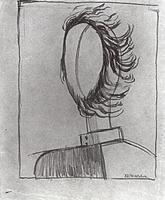
Men's head
Kazimir Malevich
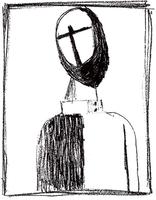
Mystic
Kazimir Malevich
Female image. Sketch
Hryhorii Havrylenko

Three heads
Kazimir Malevich
Dispute d'argent
Aurel Cojan
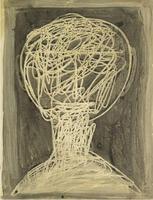
Head
Victor Brauner
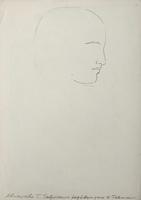
An outline of the female image
Hryhorii Havrylenko
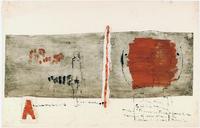
O Goden
Anton Heyboer
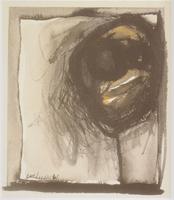
Untitled
Eva Hesse
Madame Othon Friesz, La Marseillaise
Amedeo Modigliani
Sketch with the image of a stone woman
Hryhorii Havrylenko
G-1
Emil Schumacher
The principle of painting the walls
Kazimir Malevich
Roast
Jean-Michel Basquiat
Untitled
Moshe Kupferman
Composition bleue, jaune et grise
Serge Poliakoff
Untitled
Wilhelm Sasnal
Sirene
Enrico Prampolini