Serge Poliakoff の Composition bleue, jaune et grise の専門的な分析
スタイル:Tachisme · ジャンル:abstract
Expert Art Historical Analysis: Composition bleue, jaune et grise by Serge Poliakoff
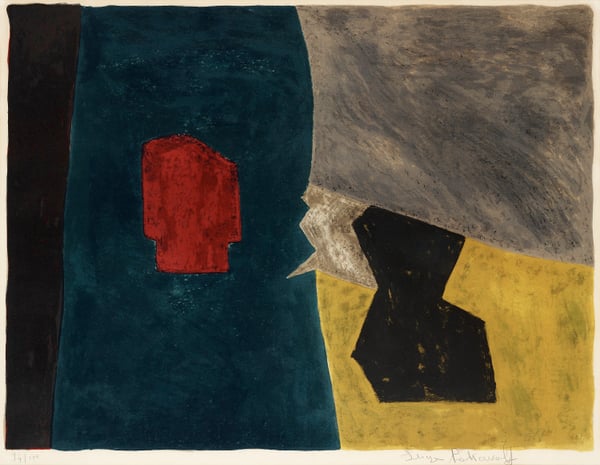
Within the framework of Tachisme—the French, gestural branch of Art Informel that emerged in the 1940s–1950s—Serge Poliakoff’s Composition bleue, jaune et grise occupies a distinctive position. Unlike the more aggressive, calligraphic spontaneity of fellow Tachistes (e.g., Pierre Soulages or Jean Fautrier), Poliakoff refined the movement’s emphasis on pure color and flat, interlocking planes into a meditative, harmonious abstraction.
Significance within Tachisme and Abstract Art
-
Color as Structure, Not Decoration
The title directly announces the painting’s building blocks: blue, yellow, and gray. In Tachisme, color is liberated from representation; here Poliakoff uses these hues not as local color but as structural forces. The blue and yellow—complementary yet unequal in intensity—create a tense equilibrium, while the gray acts as a stabilizing, tonal mediator. This triadic palette exemplifies the Tachiste belief that color is the subject. -
Rejection of Geometric Abstraction
Though Poliakoff’s forms are crisp and often appear geometric (soft rectangles or freeform zones), they are not derived from hard-edged geometry or a priori systems. Instead, the shapes emerge from intuitive, layered applications of paint—a hallmark of Tachisme’s anti-Cubist, anti-Mondrian stance. The blurred edges and subtle variations in hue betray the artist’s hand, grounding the work in process rather than plan. -
Balanced Asymmetry and Spiritual Weight
Tachisme often aimed to evoke a post-war existential or spiritual interiority. In this composition, the careful distribution of color masses—neither static nor chaotic—creates a field of visual and emotional gravity. The gray patches, which could be inert, instead “breathe” against the blue and yellow, suggesting the Tachiste impulse to find order within spontaneity.
Conclusion
Composition bleue, jaune et grise is significant because it demonstrates how Tachisme could achieve formal clarity without sacrificing the movement’s core tenets of gesture and intuition. Poliakoff’s ability to render abstract color blocks as emotionally resonant, spatially dynamic entities marks him as a crucial bridge between the gestural energy of Art Informel and the more contemplative, color-field tendencies that followed.
視覚的に類似
構図やパレットが近い作品 20 件
Legend of the Orient
Jock Macdonald
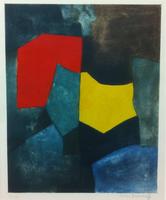
Composition multicolore à dominante bleue
Serge Poliakoff
XVI
Serge Poliakoff
Composition
Vytautas Kairiukstis
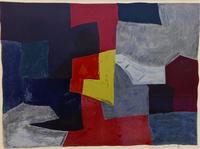
Composition grise, rouge et jaune
Serge Poliakoff
Three Kings
Theodoros Stamos
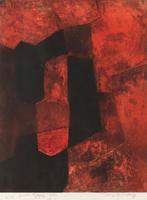
Composition brune et rouge
Serge Poliakoff
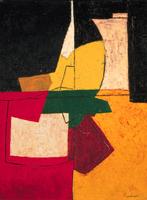
Composition abstraite aux traits
Serge Poliakoff
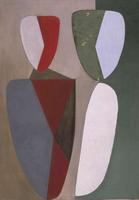
La Femme Blonde
Wolfgang Paalen
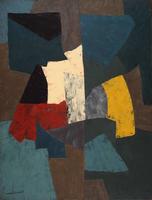
Abstract Composition
Serge Poliakoff
Heads
Vilen Barsky
The Memory of the Blue Apse
Marin Gherasim
Self-Portrait Being Duplicated into Three
Salvador Dali
Composición Cubista Con Botella
Maria Blanchard
The Glass ( The Fruit Bowl)
Juan Gris
Harlequin
Salvador Dali
Composition
Serge Poliakoff
Bodegón Con Frutero, Periódico Y Vaso. Naturaleza Muerta (La Botella)
Maria Blanchard
Bodegón Cubista
Maria Blanchard
Figure
Jean David