Kazimir Malevich の On the Boulevard の専門的な分析
スタイル:Fauvism · ジャンル:portrait
Expert Analysis: "On the Boulevard" by Kazimir Malevich
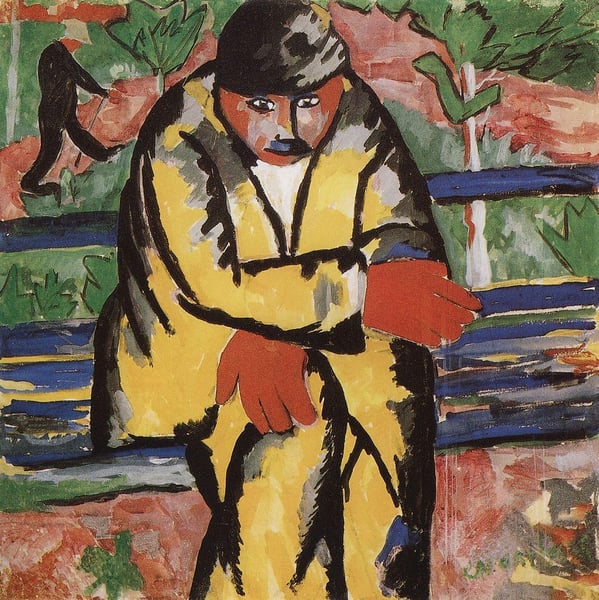
While Kazimir Malevich is best known for pioneering the radical abstraction of Suprematism, this early work, On the Boulevard, belongs to his pre-abstract period and is significant as a vivid demonstration of his engagement with Fauvism. The painting functions as a portrait, but its true subject is the liberation of color and the expressive power of the artist's subjective response to the modern urban scene.
Significance within Fauvism and the Portrait Genre:
- Bold, Non-Naturalistic Color Palette: True to the Fauvist ethos, Malevich abandons local color in favor of intense, arbitrary hues. The face and figure are constructed from patches of pure, unmixed paint—perhaps vivid greens, oranges, or pinks—that do not mimic reality but rather convey the sensation of light, atmosphere, and emotional vitality. This chromatic independence marks a decisive break from Impressionism’s naturalistic observation.
- Simplified, Expressive Form: The portrait is not concerned with meticulous anatomical accuracy or psychological depth. Instead, Malevich simplifies the figure into broad, flat planes and strong outlines, echoing the Fauvist interest in primitivism and the decorative arts. The contour of the boulevard setting (likely a promenade or street scene) is reduced to rhythmic, almost abstract shapes, foreshadowing his later move toward geometric abstraction.
- Modern Life Subject with Fauvist Lens: The title On the Boulevard places the figure firmly in the context of modern urban leisure—a theme beloved by the Fauves and Post-Impressionists. By applying a Fauvist treatment to a portrait of a contemporary Parisian (or Russian) city-dweller, Malevich does not simply depict a person; he captures the quickened pulse, the sensory overload, and the chromatic brilliance of the modern metropolis.
What Makes This Work Notable:
As a transitional work, On the Boulevard is significant because it reveals Malevich experimenting with the very tools (pure color, flattened space, emotional expressivity) that he would later push to their logical extreme in his Suprematist compositions. It shows that even in his figurative phase, Malevich was already prioritizing the autonomy of the painting’s formal elements over the accurate representation of the world—a crucial step toward the non-objective art that would define his legacy. The portrait becomes a record not of a specific individual, but of a moment in art history when color itself took center stage.
Museum / Gallery
視覚的に類似
構図やパレットが近い作品 20 件
Spanish boy
Pyotr Konchalovsky
The Reader
Edouard Vuillard
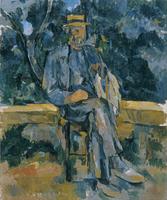
Portrait of Peasant
Paul Cezanne
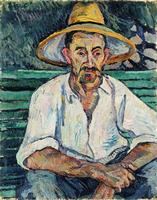
Gardener
Pyotr Konchalovsky
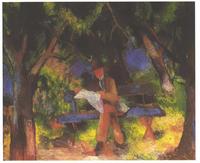
Reading man in park
August Macke
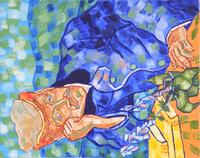
55. Portrait of Doctor Gachet 2017 by Anthony D. Padgett (after Van Gogh, Auvers Sur Oise 1890)
Anthony Padgett
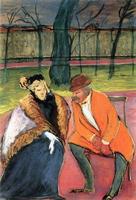
Untitled
Marianne von Werefkin
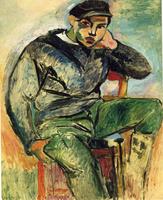
The Young Sailor I
Henri Matisse
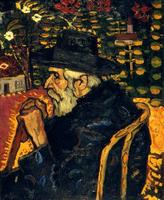
Portrait of My Grandfather
Ion Tuculescu
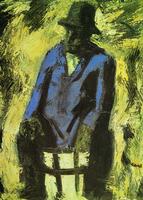
The blue jacket
Mario Sironi
Japanese Girl
Hans Hofmann
Scheiber Hugó, Padon Ülők,.
Scheiber Hugó
Untitled - Portrait with Flowers
Sandro Chia
Self Portrait
Charles Laval
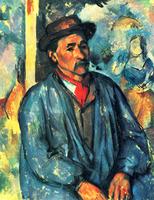
Peasant in a Blue Smock
Paul Cezanne
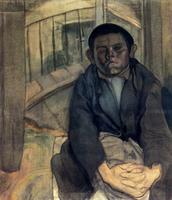
The village idiot
Carlos Saenz de Tejada
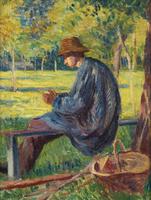
Ludovic Rodo Pissarro in the Garden of His Father in Eragny
Maximilien Luce
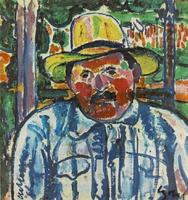
Man with Straw Hat
Bela Czobel
Woman with cap
Pablo Picasso
Boy in Shorts
Amedeo Modigliani