
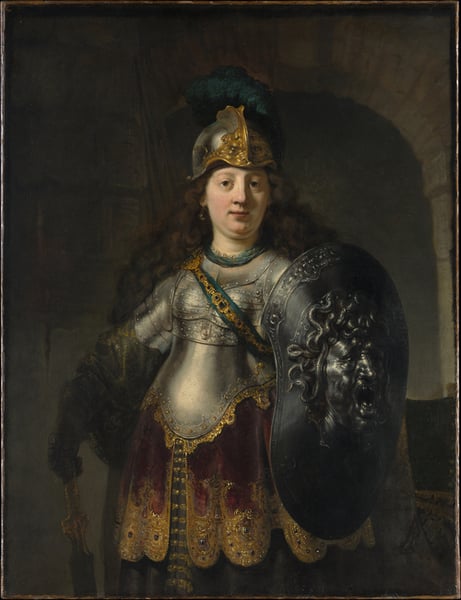
Analisi esperta di Bellona di Rembrandt
Stile: Baroque, Tenebrism · Genere: mythological painting
Expert Analysis of Rembrandt’s Bellona (c. 1633)
Rembrandt’s Bellona stands as a singular achievement within Baroque mythological painting, synthesizing the dramatic chiaroscuro of Tenebrism with a profoundly humanistic approach to classical divinity. Painted during the artist’s Amsterdam heyday, the work reimagines the Roman goddess of war not as an allegorical ideal, but as a flesh‑and‑blood woman—a choice that marks Rembrandt’s departure from the courtly conventions of his contemporaries.
The composition exemplifies Tenebrism through its stark, Caravaggesque contrast of light and shadow: Bellona’s face and gleaming armor emerge from a deep, enveloping darkness, while her left hand rests on a shield and her right holds a sword. Yet Rembrandt subverts the typical martial aggression of such imagery. The goddess’s expression is contemplative, almost melancholic, her gaze averted—suggesting the psychological weight of war rather than its glory. This introspective quality is a hallmark of Rembrandt’s Baroque portraiture, infusing a mythological subject with the same emotional gravity he brought to biblical and everyday scenes.
Art historically, Bellona is significant as one of Rembrandt’s few mythological commissions (most of his oeuvre focuses on history or religion). The painting demonstrates his mastery of impasto in the metallic sheen of the armor and the softness of the plumed helmet, while the earthy palette and loose brushwork ground the figure in tactile reality. By humanizing the goddess—rendering her as a contemporary woman in antique costume—Rembrandt bridges the distance between myth and viewer, a revolutionary approach that anticipates the psychological realism of later Western art. In this work, Tenebrism becomes not merely a stylistic device but a metaphor for the chiaroscuro of human conflict itself.
Visivamente simili
20 opere con composizione e palette affini
A Man in Armour
Rembrandt
The Archangel Michael
Francisco de Zurbaran
Philipp Wilhelm of Brandenburg Schwedt
Antoine Pesne
Portrait of the Duc de Broglie
Hyacinthe Rigaud
Alexander the Great
Rembrandt
Louis De France, Duc De Bourgogne
Hyacinthe Rigaud
Retrato de Francisco II della Rovere
Federico Barocci
Colonel John Strode
John Hayls
PORTRAIT DES CHARLES DU HAN DE MARTIGNY ALS KOMMANDANT
Constantijn Netscher
Portrait of the Princes Palatine Charles Louis I and his Brother Robert
Anthony van Dyck
Portrait of a Young Philippe D'Orléans, Duke of Chartres, Regent of France
Hyacinthe Rigaud
Cornelis Evertsen (1642 - 1706), Lieutenant Admiral of Zeeland
Nicolaes Maes
Sir John Pole
John Riley
PORTRAIT OF A MAN, HALF-LENGTH, IN ARMOUR, WEARING A HELMET AND A FUR CAPE, HOLDING A SET OF PLAYING CARDS IN HIS LEFT HAND, WITH ANOTHER FIGURE AT HIS SIDE
Stefano Torelli
Portrait of Charles II of England in Armour
Gerard van Honthorst
Portrait de Louis III de Condé
Jean-François de Troy
Portrait of a Young General
Anthony van Dyck
Portrait of Sir William Widdrington, 2nd Baron Widdrington of Blankney (d.1675), standing three-quarter-length, in a buff coat with white sleeves with red bows, his hand resting on a helmet and holding a baton, a young boy, possibly his son or page, at his side holding a breastplate, a view to a battle beyond with erroneous identifying inscription 'Sυr. Wυm. Widdrington Kυt. v Barυt./1υsυt Lord Widdrington of Blankney
Jacob Huysmans
Portrait of a Man (wrongly said to be Sir Thomas Chicheley, 1618–1699)
John Hayls
Louis XIII
Peter Paul Rubens