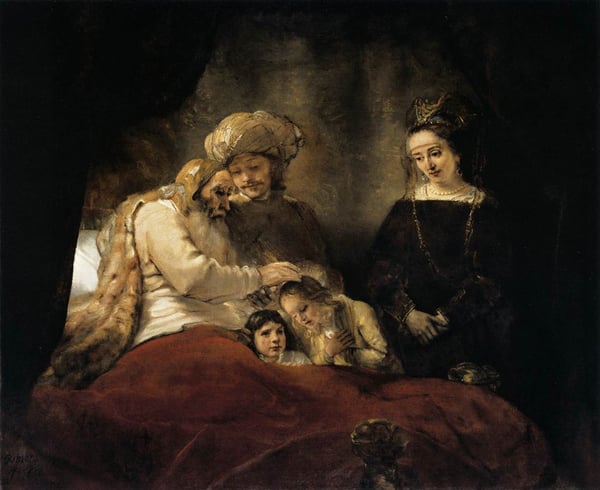
Expert analysis of Rembrandt’s Jacob Blessing the Children of Joseph
Style: Baroque, Tenebrism · Genre: religious painting
Expert Analysis: "Jacob Blessing the Children of Joseph" by Rembrandt
As a prime example of Baroque religious painting, Rembrandt’s work derives its significance from the masterful application of Tenebrism—the dramatic use of deep shadow and intense light to heighten emotional and spiritual intensity. In this scene, the stark chiaroscuro isolates the frail, blind Jacob as he extends his hands over the two children, while Joseph and his wife Asenath recede into shadow. This light-dark contrast does more than create theatrical depth; it transforms a simple family moment into a sacred revelation. The darkness surrounding the figures strips away worldly distractions, focusing the viewer entirely on the act of benediction—a testament to Rembrandt’s ability to merge Baroque dynamism with profound psychological truth.
What makes the work especially significant within the Baroque period is how Rembrandt subverts conventional Tenebrism. Unlike Caravaggio’s stark, almost confrontational lighting, Rembrandt’s light is soft, enveloping, and deeply human. It emerges from an unseen source, like grace itself, illuminating Jacob’s weathered face and trembling hands. The gesture of blessing is rendered with tender ambiguity—one hand crosses over the other, echoing the biblical narrative of the younger son receiving the greater blessing. This subtle, moving detail, brought to life by Tenebrism’s focus on gesture and expression, elevates the painting from mere scriptural illustration to a meditation on mortality, legacy, and divine favor. It stands as a hallmark of Baroque’s ability to fuse the sacred with the intimately human.
Museum / Gallery
Genre
Visually similar
20 works with related composition and palette
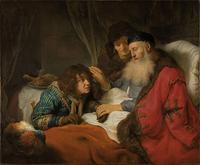
Isaac Blessing Jacob
Govert Flinck
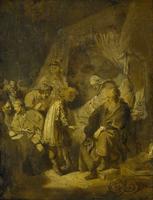
Joseph tells his dreams to his parents and brothers
Rembrandt
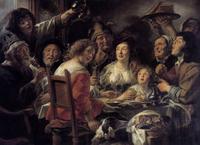
The King Drinks
Jacob Jordaens
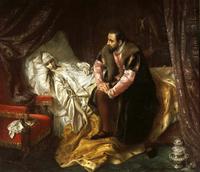
Death of Barbara Radziwillowna
Jozef Simmler
Preparatory sketch for The will of Isabella the Catholic
Eduardo Rosales
A Soldier, An Old Woman and a Young Woman
Pieter Codde
The Prodigal Son
Gabriel Metsu
Joseph Accused by Potiphar's Wife
Rembrandt
Jacob Reproaching Laban
Hendrick Terbrugghen
The Banquet of Cleopatra
Jan de Bray
Macready as Werner
Daniel Maclise
Doctor's Visit
Jan Steen
Masquerade
Antoine Watteau
The Glass of Lemonade
Gerard Terborch
The Dropsical Woman
Gerrit Dou
Breakfast
Gabriel Metsu
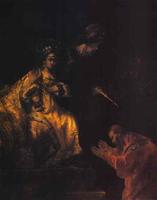
Haman Begging Esther for Mercy
Rembrandt
Samson and Delilah
Jan Steen
Peasants' meal
Mikhail Shibanov
Esther, Ahasuerus, and Haman
Jan Steen