
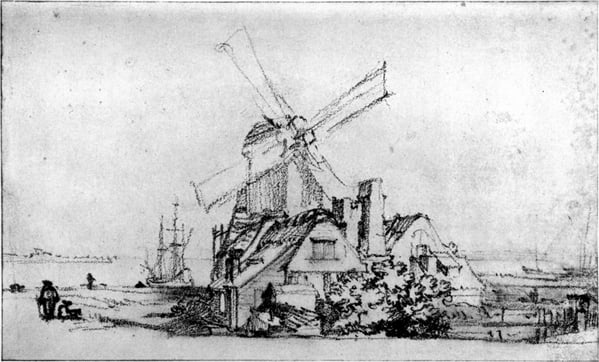
Analisi esperta di The bastion in Amsterdam di Rembrandt
Stile: Baroque · Genere: landscape
Expert Art Historical Analysis:
"The Bastion in Amsterdam" by Rembrandt van Rijn
Style: Baroque | Genre: Landscape
Significance within the Baroque Period and Rembrandt’s Oeuvre
Rembrandt’s “The Bastion in Amsterdam” occupies a distinctive place in both his personal corpus and the broader Baroque landscape tradition. While Rembrandt is universally celebrated for his penetrating portraits, biblical narratives, and masterful chiaroscuro, his landscapes—often executed as etchings or drawings—reveal a quieter, yet equally revolutionary, side of his genius.
1. Departure from Idealized Landscape Conventions
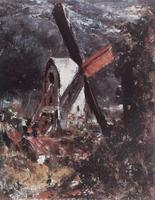
In contrast to the grand, mythologized landscapes favored by many Baroque painters (such as Claude Lorrain’s arcadian vistas or Poussin’s structured compositions), Rembrandt’s rendering of a humble city fortification is markedly naturalistic. He focuses on the commonplace: a simple bastion, probably part of Amsterdam’s 17th-century defensive walls, with a windmill or low buildings, under a sky heavy with atmosphere. This shift toward topographic accuracy and everyday urban scenery aligns with the Dutch Golden Age’s emphasis on local pride and empirical observation.
2. Mastery of Atmospheric Light and Mood
Even in a landscape, Rembrandt’s hallmark manipulation of light and shadow is evident. He uses subtle gradations of tone—likely achieved through delicate etching techniques or broad washes if a drawing—to evoke the damp, maritime light of the Netherlands. The bastion itself may be partially in shadow, while a patch of sky or a distant canal catches a soft glow. This creates a sense of transient weather, a hallmark of Baroque energy, but rendered with introspection rather than theatrical drama.
3. Integration of Human Presence and City Identity
Though a landscape, the work often includes small figures—a passerby, a boat, or workers—anchoring the scene in daily life. This reflects the Baroque interest in the dynamic interaction between humanity and environment. The bastion, a symbol of civic defense and commercial prosperity, becomes a quiet monument to Amsterdam’s burgeoning mercantile power, yet Rembrandt treats it with the same empathetic observation he applied to his portraits of the poor or elderly.
4. Technical and Compositional Originality
Rembrandt’s landscapes are characterized by loose, sketchy strokes when etched, and an almost modern sense of cropping. The viewer’s eye is led along diagonal lines—perhaps a canal bank or the bastion’s sloping earthwork—into a hazy distance. This asymmetry and unfinished quality prefigure later Romantic notions of the sublime and anticipate the 19th-century plein-air revolution.
Conclusion
“The Bastion in Amsterdam” is significant because it demonstrates that Rembrandt could invest the most unassuming subject—a neglected corner of his hometown—with the same psychological depth and atmospheric power that define his greatest works. It stands as a testament to the Dutch Baroque’s unique contribution: finding the extraordinary within the ordinary, and capturing the fleeting beauty of light itself.
Museum / Gallery
Genere
Stile
Visivamente simili
20 opere con composizione e palette affini
The Mill on the Het Blauwhoofd
Rembrandt
Landscape with mill and cattle
Jacob van Strij
Landscape with watermill
Jacob van Strij

St Aubin's Bay, Jersey
James Webb
Mills in the Neighbourhood of Dordrecht
Vincent van Gogh
Summer
Jan van Goyen
Gardens on Montmartre and the Blute-Fin Windmill
Vincent van Gogh

Dutch Landscape
Jan van Goyen
The Knocke Windmill, Belgium
Camille Pissarro
Windmill
David Cox
Windmills, Blackheath
Edward William Cooke
Landscape with a mill
Johan Hendrik Weissenbruch
Rest by a Windmill
Jan Brueghel the Elder
Windmill at Montmartre
Vincent van Gogh
Windmills at Montmartre
Vincent van Gogh
Landscape with Cattle and Windmills
Léon-Victor Dupré
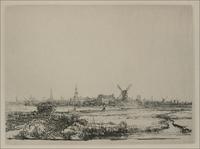
View of Amsterdam
Rembrandt

Windmills in the Ukrainian steppe at sunset
Ivan Aivazovsky
A Windmill near Brighton
John Constable

The Windmill
Jules Dupre