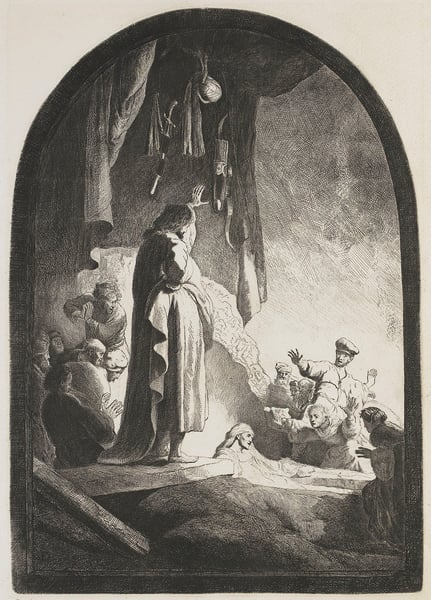
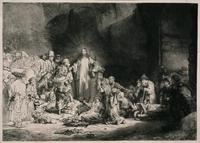
The significance of Rembrandt's "The Raising of Lazarus" within the Baroque style and the religious painting genre lies in its masterful embodiment of Baroque principles: dramatic chiaroscuro, intense emotional realism, and a dynamic composition that transforms a biblical miracle into a deeply human encounter. Rembrandt uses strong contrasts of light and shadow to isolate the figure of Christ and the emerging Lazarus, directing the viewer’s gaze to the pivotal moment of resurrection. The emotional responses of the surrounding witnesses—from astonishment to faith—are rendered with psychological depth, a hallmark of Baroque religious art aimed at inspiring personal devotion. This work is significant for its ability to capture both the supernatural power and the intimate humanity of the Gospel narrative, showcasing Rembrandt’s unique fusion of technical virtuosity and spiritual insight within the Baroque tradition.