Expert analysis of Rembrandt’s The Supper at Emmaus
Style: Baroque · Genre: religious painting
As an expert art historian, I will provide an analysis based solely on the supplied structured facts: Artwork: "The Supper at Emmaus" by Rembrandt; Style: Baroque; Genre: religious painting.
Expert Analysis
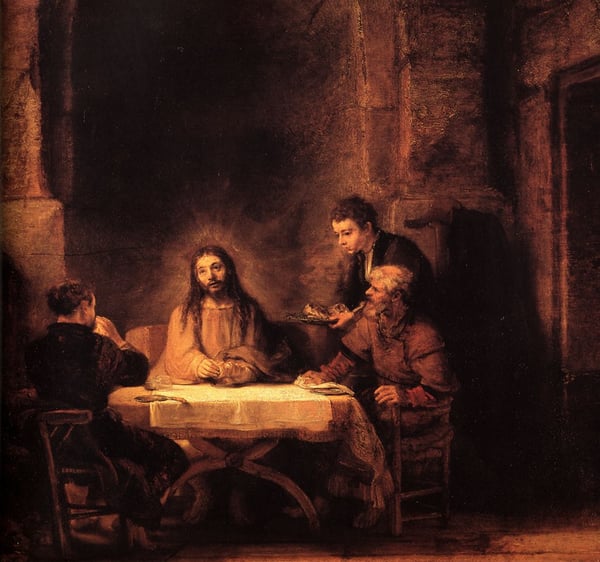
Rembrandt’s The Supper at Emmaus is a masterful example of Baroque religious painting, and its significance lies in how the artist adapts the core principles of the Baroque style—drama, emotion, and dynamic composition—to a deeply intimate and humanistic interpretation of a sacred narrative.
Baroque Innovation in Religious Genre
Within the Baroque tradition, religious paintings were often grand, theatrical, and filled with soaring celestial light to emphasize divine majesty. Rembrandt subverts this expectation. Instead of a sweeping, supernatural revelation, he focuses on a quiet, domestic moment. The drama is not in action but in the psychological impact of recognition. This is a hallmark of his unique Baroque approach: using extreme chiaroscuro (strong contrasts of light and dark) not merely for theatrical effect, but to direct the viewer’s attention to the most profound human reaction.
Significance of the Composition
The painting’s significance is rooted in its treatment of the biblical moment (Luke 24:30–31) when two disciples suddenly recognize the risen Christ as he breaks bread. Rembrandt’s Baroque sensibility transforms this into a study of revelation through ordinary means. The light source—often emanating from Christ himself or from the table—throws the figures into relief, isolating their faces and hands. The disciples’ astonishment is conveyed through subtle gesture and shadow, rather than exaggerated emotion. This quiet, interior drama is central to Rembrandt’s contribution: he humanizes the Baroque religious genre by making the divine accessible through humble, shared experience.
Legacy in Religious Painting
As a religious painting, The Supper at Emmaus redefines piety. Where other Baroque painters (like Caravaggio) used stark realism and tenebrism to create a sense of immediacy, Rembrandt adds a layer of contemplative intimacy. The significance is that the sacred is not shown as a distant miracle but as a present, personal event—a characteristic that would influence later narrative painting. The work thus stands as a pivotal fusion of Baroque drama with deeply empathetic storytelling, marking Rembrandt’s singular voice within the religious genre.
Museum / Gallery
Genre
Style
Visually similar
20 works with related composition and palette
Supper at Emmaus (after Rembrandt Van Rijn)
Thomas Stuart Smith
Wishart's Last Exhortation
William Quileer Orchardson
Tobias's Farewell to his Parents
Samuel Dirksz van Hoogstraten
Supper at Emmaus
Jan Steen
The Pilgrims of Emmaus
Henry Ossawa Tanner
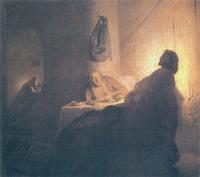
The Supper at Emmaus
Rembrandt
Last Supper
Nikolai Ge
Grace Before Meat
David Wilkie
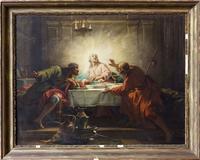
The Pilgrims of Emmaus
Jean II Restout
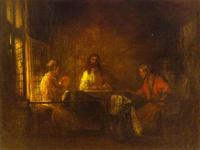
The Pilgrims at Emmaus
Rembrandt
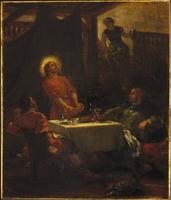
The Disciples at Emmaus
Eugene Delacroix
The Cotter's Saturday Night
David Wilkie
Pashur Smiting Jeremiah in the Temple
Leonaert Bramer
Parable of the Laborers in the Vineyard
Rembrandt
The Card Players
Eduard von Grützner
Parable of the Workers in the Vineyard
Salomon Koninck
The Last Supper
Peter Paul Rubens
ZACHARIAS WRITING THE NAME OF SAINT JOHN THE BAPTIST
Hendrik Heerschop
Streik
Theodor Severin Kittelsen
Friend of the Humble (Supper at Emmaus)
Léon Augustin Lhermitte