
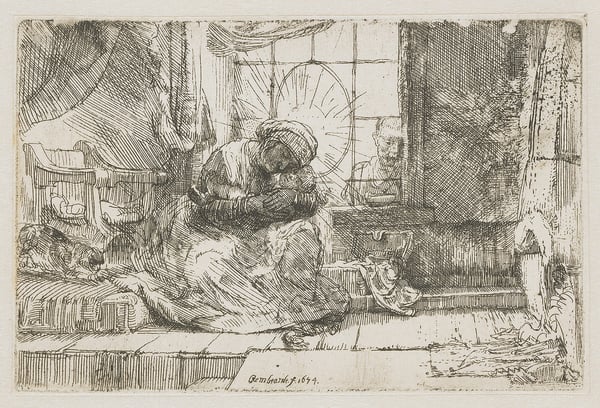
Expertenanalyse zu Rembrandts The Virgin and the child with the cat and snake
Stil: Baroque · Genre: religious painting
Expert Analysis: "The Virgin and the Child with the Cat and Snake" by Rembrandt
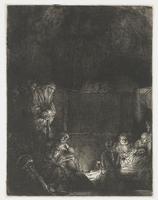
Rembrandt’s “The Virgin and the Child with the Cat and Snake” is a striking example of Baroque religious painting that transcends conventional devotional imagery through its intimate, psychological realism and masterful manipulation of light. Executed in the early 17th century, this work reveals Rembrandt’s distinctive ability to merge the sacred with the everyday, a hallmark of his mature style.
Significance within the Baroque Period:
The painting exemplifies the Baroque emphasis on drama, tension, and emotional immediacy. Rather than presenting the Virgin and Child as remote, hieratic figures, Rembrandt places them in a domestic interior, bathed in a warm, chiaroscuro glow that directs the viewer’s eye to the tender interaction between mother and son. The inclusion of a cat and a snake is highly unusual for a traditional Madonna and Child composition, and it is here that the work gains its theological and symbolic depth.
Symbolic and Thematic Innovation:
The snake, a classic emblem of sin, evil, and the Fall of Man, introduces a note of menace into an otherwise serene scene. The cat, often associated with domesticity but also with cunning or independence, may represent the taming of primal instincts or the intrusion of the mundane into the holy narrative. Rembrandt likely intended the snake to foreshadow Christ’s future victory over sin and death—a subtle reference to the Protoevangelium (Genesis 3:15), where the woman’s offspring crushes the serpent’s head. By placing the cat as an intermediary—curious, playful, or protective—Rembrandt humanizes the divine family, suggesting that the Incarnation unfolds within the messy, tangible world of ordinary life.
Artistic Mastery:
Technically, the painting showcases Rembrandt’s unparalleled handling of light. A soft, golden illumination falls on the Virgin’s face and the Child’s body, while the cat and snake recede into shadowy half-tones, creating a dynamic contrast between the sacred and the profane. The brushwork is both precise and fluid, capturing the textures of fabric, fur, and skin with an almost tactile quality. This fusion of naturalistic detail and symbolic resonance makes the work a quintessential Baroque statement: divine truth revealed through the senses.
Legacy:
In its blending of genre-like domesticity with profound religious allegory, “The Virgin and the Child with the Cat and Snake” is significant for challenging the formal boundaries of religious art. Rembrandt here invites the viewer into a moment of quiet contemplation, where the supernatural is made accessible—and unsettling—through the familiar. This painting remains a compelling testament to the artist’s insistence that holiness dwells not in grand cathedrals alone, but in the intimate, shadowed corners of human experience.
Visuell ähnlich
20 Werke mit ähnlicher Komposition und Farbpalette
The Holy Family with a cat
Rembrandt
The holy family
Rembrandt
The Angel Departing from the Family of Tobias
Rembrandt
Christ disputing with the doctors
Rembrandt
Old woman seated in a cottage with a string of onions on the wall
Rembrandt
Beggar man and woman
Rembrandt
Angel Departing from the Family of Tobias
Rembrandt
Jewish Woman of Algiers
Eugene Delacroix
Jesus Disputing with the Doctors
Rembrandt
Charitable
Paul-Albert Besnard
The Holy Family in the arbor
Albrecht Durer
Otto of the Silver Hand 7
Howard Pyle
The porridge
Jean-Francois Millet
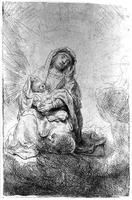
Madonna and Child in the Clouds
Rembrandt
The Schoolmaster
Rembrandt
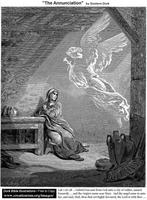
The Annunciation
Gustave Dore
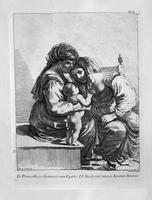
St. Anne, the Virgin and Child Jesus
Giovanni Battista Piranesi
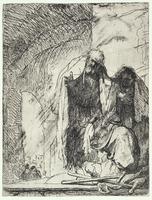
Peter and John at the gate of the Temple
Rembrandt
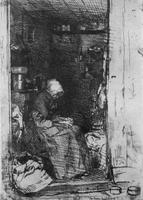
Old Woman with Rags
James McNeill Whistler
The entombment
Rembrandt