
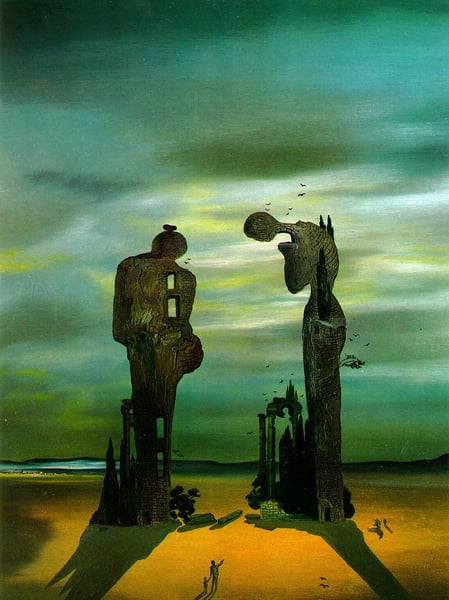
Archeological Reminiscence Millet's Angelus
Подробности
Экспертный разбор работы «Archeological Reminiscence Millet's Angelus» художника Salvador Dali
Стиль: Surrealism · Жанр: landscape
This analysis is based solely on the provided structured facts.
Artwork: Archeological Reminiscence Millet's Angelus by Salvador Dalí
Style: Surrealism
Genre: Landscape
Period: Surrealism Period (1929–1940)
Analysis of Significance
Dalí’s Archeological Reminiscence Millet's Angelus is a landmark work within the Surrealism Period (1929–1940) that exemplifies how the movement transformed a traditional genre—landscape—into a vehicle for psychological and symbolic exploration. The painting’s significance lies in its radical reinterpretation of a familiar, pious scene (Jean-François Millet’s The Angelus) through Dalí’s signature method of “paranoiac-critical” transformation.
As a surrealist landscape, the work abandons realistic depiction in favor of a dreamlike, dilapidated environment. The two praying figures from Millet’s original are rendered as monolithic, decaying architectural ruins—an “archeological reminiscence” that suggests memory, time, and subconscious obsession. By recasting a static, devotional image as a vast, eroded landscape, Dalí blurs the boundary between human figures and geological formations, a hallmark of his surrealist period.
The landscape genre here is not passive but actively participates in the surrealist goal of destabilizing reality. The barren, crumbling terrain evokes both ancient ruins and the erosion of memory, while the towering, petrified couple seem to emerge from the earth itself. This fusion of human and landscape underscores Dalí’s interest in buried desires and the persistence of the past. Within the Surrealism Period (1929–1940), the work stands as a prime example of how Dalí used landscape to externalize internal psychic states, making the familiar strange and the monumental fragile.
Визуально похожие
20 работ с близкой композицией и палитрой
Composition - Portrait of Mrs. Eva Kolsman
Salvador Dali
Untitled (Landscape)
Salvador Dali
Gradiva Finds the Anthropomorphic Ruins
Salvador Dali
Portrait of Mrs. Ann Woodward
Salvador Dali
Ruin with Head of Medusa and Landscape
Salvador Dali
Spellbound
Salvador Dali
Ambivalent Image
Salvador Dali
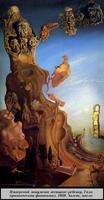
Imperial Monument of Woma-Child. Gala (Utopian Fantasy)
Salvador Dali
Design for the set of the film 'Spellbound'
Salvador Dali
Nude in the Desert Landscape
Salvador Dali
The Temple of Remembering
Sabin Balasa
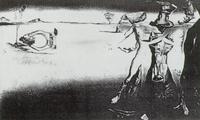
Apparition of a Couple in the Desert
Salvador Dali
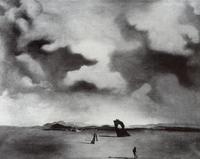
Night Spectre on the Beach
Salvador Dali
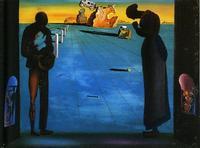
Angelus
Salvador Dali
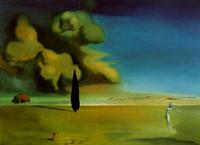
Apparition of My Cousin Carolinetta on the Beach at Rosas
Salvador Dali
Remorse, or Sphinx Embedded in the Sand
Salvador Dali

The Sense of Speed
Salvador Dali
Portrait of Isabelle Baker Woolley, (1935)
Salvador Dali
Weight of the Soul
Wojciech Siudmak
Necrophiliac Springtime
Salvador Dali