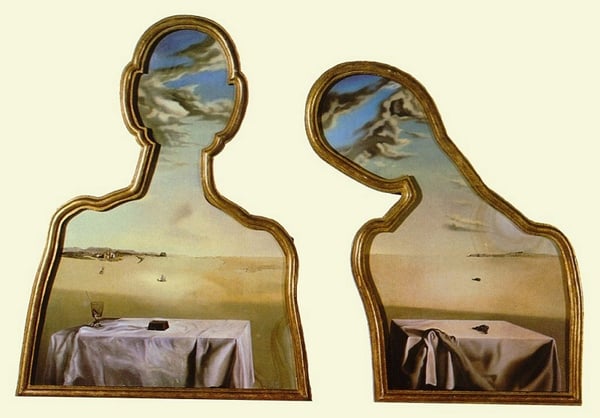
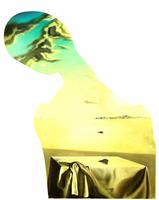
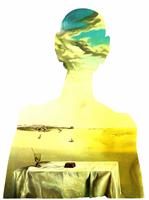
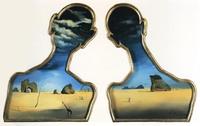
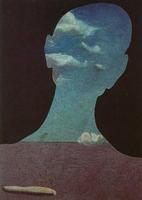
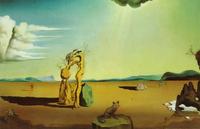
Salvador Dalí’s Couple with Their Heads Full of Clouds (c. 1936–1937) exemplifies the Surrealist obsession with the irrational and the dream-state. Executed during his definitive Surrealist period (1929–1940), the painting deploys Dalí’s signature “paranoiac-critical method” to dissolve the boundaries between inner psychology and external reality. The most striking feature is the substitution of the couple’s heads with billowing clouds—a literalization of the phrase “head in the clouds” that transforms a romantic cliché into a haunting visual metaphor. By replacing human identity with mutable, atmospheric forms, Dalí challenges the stability of the self and the fixity of perception. The figures’ bodies remain grounded and strangely stiff, creating a jarring contrast between the fluid, porous minds and the solid, sculpted torsos. This tension between the material and the immaterial is quintessentially Surrealist: it probes the subconscious as a site of liberation, where reason gives way to desire and fantasy. The work is significant within Dalí’s oeuvre for its intimate scale and its fusion of erotic tension with metaphysical uncertainty, reflecting the movement’s broader aim to reconcile dream and reality into an absolute—or “surreality.”