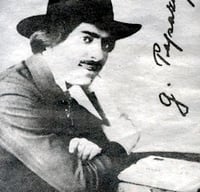
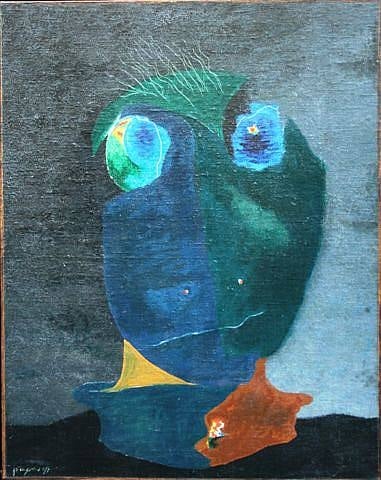
Analisi esperta di Tête fantastique di Georges Papazoff
Stile: Surrealism · Genere: figurative
Expert Analysis of "Tête fantastique" by Georges Papazoff
Georges Papazoff’s "Tête fantastique" stands as a compelling example of Surrealist figurative practice, where the recognizable human form is deliberately distorted to access the irrational and dreamlike realms central to the movement. Created by the Bulgarian-born French Surrealist—an artist who, though less widely known, was an active participant in the Parisian Surrealist circle of the 1920s and 1930s—this work demonstrates the period’s fascination with the fantastique as a means of challenging rational perception.
The painting’s significance lies in its embodiment of the Surrealist principle of dépaysement (displacement or unsettling transformation). By taking a conventional portrait subject (a “head”) and rendering it “fantastic,” Papazoff subverts the tradition of portraiture. The figurative genre provides a recognizable anchor—a face, a skull, or a bust—that the artist then warps through exaggeration, fragmentation, or biomorphic hybridity, forcing the viewer to confront the uncanny. This tension between the familiar and the alien is a hallmark of Papazoff’s own oeuvre, which often explored automatism and spontaneous, subconscious forms.
In the context of Surrealism, "Tête fantastique" is significant because it represents the movement’s broader goal of liberating the imagination from logical constraints. Papazoff, like other Surrealists, used the human figure not as a faithful likeness but as a vessel for psychological intensity. The work’s fantastique quality aligns it with the visionary and often grotesque motifs found in artists such as Salvador Dalí or Max Ernst, yet Papazoff’s particular handling of the figurative genre—grounded in a delicate balance between abstraction and representation—offers a distinct, more introspective take on the Surrealist dreamscape. It reminds us that even within a highly stylized movement, the figurative tradition could be reinvented as a gateway to the unconscious.
Genere
Stile
Visivamente simili
20 opere con composizione e palette affini
Tête
Georges Papazoff
Evening shows
Paul Klee
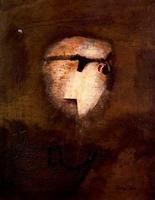
Criptis
Modest Cuixart
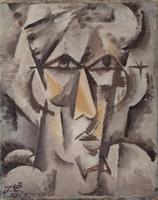
Hlava (Autoportrét)
Josef Capek
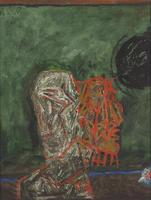
Untitled
M.F. Husain
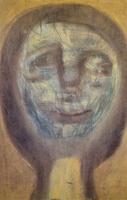
Vajda Lajos Zöld Bohócmaszk 1938
Vajda Lajos
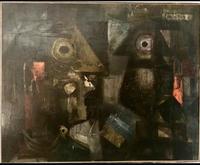
A012 - Le Roy
Ramiro Martín Martín
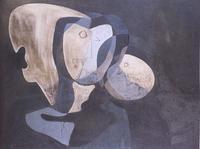
Cubist Figure
Salvador Dali
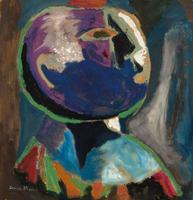
Anna Margit, Üveggömben Lévő Fej 1946
Anna Margit
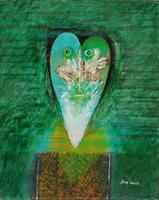
Heart
Jean David
Anna Margit, Halász 1947
Anna Margit
Head of a Man
Joan Miro
Tête de femme, Vézelay
Le Corbusier
Anna Margit, Sárga Sapka 1946
Anna Margit
Head Portrait
Jean David
Cubist Composition
Maria Blanchard
Figure
Jean David
Composition au visage et au coquillage
Louis Marcoussis
Brown Still Life
Georges Braque
Concert
Louis Marcoussis