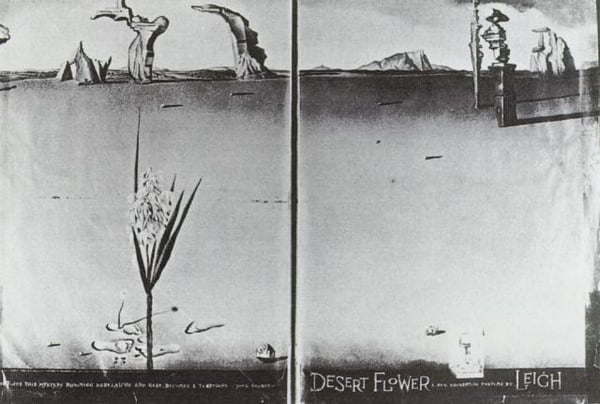
Flower in the Desert
Ayrıntılar
Salvador Dali sanatçısının Flower in the Desert eseri hakkında uzman analizi
Tarz: Surrealism · Tür: landscape
Expert Analysis: "Flower in the Desert" by Salvador Dalí
Salvador Dalí’s Flower in the Desert, painted during his Classic Period (1941–1989), exemplifies the mature phase of his surrealist practice—a time when he shifted from the radical automatism of his early years toward a meticulously rendered, almost academic style infused with symbolism, mysticism, and a deep engagement with the natural sciences. This work is significant for how it distills the core surrealist strategy of uncanny juxtaposition into a deceptively simple landscape, while also embodying Dalí’s later preoccupations with duality, persistence, and the tension between life and desolation.
Surrealist Juxtaposition in a Barren Landscape
As a landscape, Flower in the Desert eschews Dalí’s more famous “hand-painted dream photographs” of melting clocks and distorted figures. Instead, it relies on a stark, archetypal contrast: a single, delicate blossom blooming in an arid, infinite waste. This is classic surrealism—forcing together the organic and the inorganic, the fragile and the harsh, the transient and the eternal. The flower, likely rendered with Dalí’s characteristic hyperrealistic precision, becomes an emblem of the irrational triumph of life over sterility. In the context of surrealism, such a motif challenges the viewer’s logical expectations, prompting a psychological or dreamlike reading: hope in the void, beauty in despair, or the resilience of the subconscious.
Significance Within Dalí’s Classic Period
Dalí’s Classic Period marks his return to traditional techniques, religious subjects (e.g., The Sacrament of the Last Supper), and a fascination with nuclear mysticism. Flower in the Desert can be seen as a secular counterpart to those works—a meditation on creation and survival in a post-war world. The desert, a recurring Dalí motif (from The Persistence of Memory’s barren backdrop to his landscapes of Port Lligat), here functions as a psychological or cosmic stage. The flower’s isolation amplifies its significance: it is not part of a garden but a singular anomaly, suggesting Dalí’s interest in the “paranoiac-critical method” where a single object triggers a cascade of associations. Historically, this painting also aligns with Dalí’s contemporaneous scientific interests—the flower as a biological marvel in an inhospitable environment echoes his writings on DNA and the persistence of life.
Art-Historical Impact
Within the broader surrealist movement, Flower in the Desert stands out for its restraint. Rather than overwhelming the viewer with Freudian symbols or hallucinatory clutter, Dalí achieves surrealist effect through minimalism. The void around the flower becomes as active as the blossom itself—a void filled with possible meanings (absence, time, the unconscious). This work thus bridges his early pyrotechnic surrealism with his later, more meditative classicism. It reminds us that Dalí’s true significance lies not only in his shocking images but in his ability to make the everyday (a flower) feel strange, precious, and inexplicably alive in a world that seems designed to destroy it.
In sum, Flower in the Desert is a distilled masterpiece of Dalí’s Classic Period: a surrealist landscape that uses the desert’s emptiness to heighten the flower’s symbolic power, affirming the movement’s enduring capacity to find the extraordinary in the desolate.
Görsel olarak benzer
İlişkili kompozisyon ve renk paletine sahip 20 eser
Apparition of a Couple in the Desert
Salvador Dali
Composition - Portrait of Mrs. Eva Kolsman
Salvador Dali
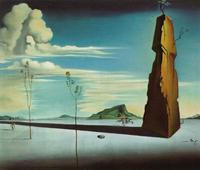
Untitled (Landscape)
Salvador Dali
Design for the set of the film 'Spellbound'
Salvador Dali
Portrait of Mrs. Ann Woodward
Salvador Dali
Landscape
Salvador Dali
Nude in the Desert Landscape
Salvador Dali
Study for "Honey is Sweeter than Blood"
Salvador Dali
Angelus
Salvador Dali
Spellbound
Salvador Dali
Average Pagan Landscape
Salvador Dali
Mama, Papa is Wounded!
Yves Tanguy
Large Painting Representing a Landscape
Yves Tanguy
Apparition of My Cousin Carolinetta on the Beach at Rosas
Salvador Dali
Shades of Night Descending
Salvador Dali
Landscape Near Ampurdan
Salvador Dali
The God of the Bay of Roses
Salvador Dali
Diurnal Fantasies
Salvador Dali
Perspectives
Salvador Dali
The Sense of Speed
Salvador Dali