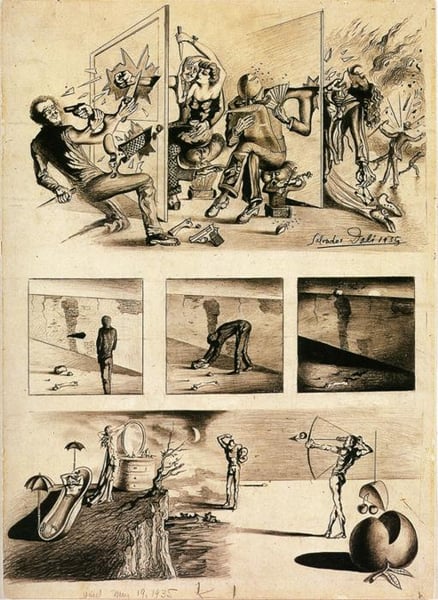
Gangsterism and Goofy Vision of New York
Подробности
Экспертный разбор работы «Gangsterism and Goofy Vision of New York» художника Salvador Dali
Стиль: Surrealism · Жанр: genre painting
Expert Art Historical Analysis: "Gangsterism and Goofy Vision of New York" by Salvador Dalí
Created during Dalí’s most productive Surrealist period (1929–1940), Gangsterism and Goofy Vision of New York exemplifies the movement’s core ambition: to disrupt rational perception and expose the subconscious. Stylistically a Surrealist genre painting, the work takes an everyday scene—urban life in New York—and transforms it into a psychologically charged, dreamlike tableau.
Significance within Surrealism:
Dalí’s “paranoid-critical method” is at play here, deliberately distorting familiar elements to challenge reality. The title itself juxtaposes two contradictory concepts: “gangsterism” (violence, order, crime) and “goofy vision” (absurdity, childishness, irrationality). This fusion mirrors Surrealism’s technique of automatic association and unexpected collisions.
Period Context (1929–1940):
This was Dalí’s era of greatest notoriety, when he produced iconic works like The Persistence of Memory. In Gangsterism and Goofy Vision of New York, he applies his signature meticulous realism to impossible scenarios—likely featuring melting or elongated forms, dislocated objects, and symbolic elements such as crutches or anthropomorphic shapes. The subject matter critiques American modernity, materialism, and the violent undercurrent of urban life, filtered through Dalí’s Spanish-Catalan perspective.
Genre Painting Reimagined:
As a genre painting, it ostensibly depicts a slice of everyday New York—but Surrealism subverts the genre’s typical faithfulness. Instead of documenting reality, Dalí presents a psychological archetype: the city as a site of both criminal menace (gangsterism) and absurdist humor (goofy vision). This duality makes the work a landmark of Surrealist social commentary, prefiguring later pop and postmodern critiques of American culture.
Why It Matters:
The painting stands out for its audacious blending of high-art technique with low-cultural subject matter (gangsters, cartoons). It captures Surrealism’s shift from purely dreamlike escapism toward pointed, even sardonic, engagement with contemporary society. In this sense, it is not merely a bizarre image but a critical mirror held up to the “American Dream”—goofy, menacing, and profoundly irrational.
Museum / Gallery
Жанр
Стиль
Визуально похожие
20 работ с близкой композицией и палитрой
Pork 8
Sue Coe
William Rush Carving The Allegorical Figure Of The Schuylkill
Thomas Eakins
Diner du Bon Bock
Theophile Steinlen
Kondor Béla, Sámsonok
Kondor Béla
Orfeu nos Infernos
Guilherme de Santa-Rita
Don Quixote
Gustave Dore
Four illustrations to a Spanish book
Rembrandt
Adam and Eve
Graham Sutherland
Untitled
Vasile Kazar
Don Quixote
Gustave Dore
Clytemnestra pushed by Mimi Veron (Rachel)
Honore Daumier
Study of compositions and figures
Noè Bordignon
A Lesson in Discretion
Cassius Marcellus Coolidge
Thiers
Honore Daumier
Dance
Salvador Dali
The Analysis of Beauty
William Hogarth
Et Puis Apres
Theophile Steinlen
The Battle of the Pictures
William Hogarth
Illustration to "A Week of Kindness"
Max Ernst
Kondor Béla, Kisemmizett Szegények
Kondor Béla