Analisi esperta di The Analysis of Beauty di William Hogarth
Stile: Rococo · Genere: illustration
Expert Analysis: "The Analysis of Beauty" by William Hogarth (Rococo, Illustration)
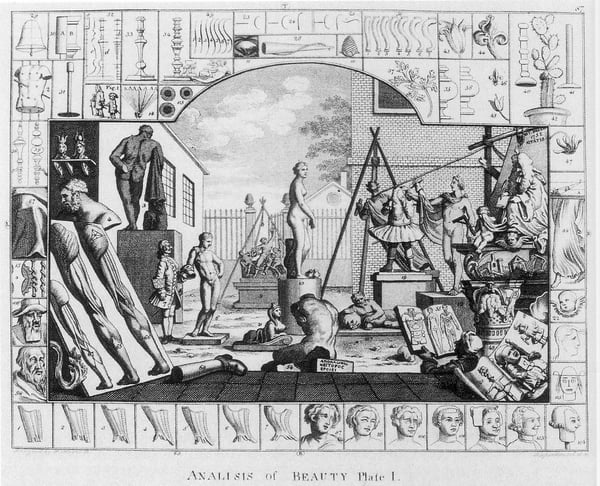
William Hogarth’s "The Analysis of Beauty" (1753) is far more than a mere illustration—it is a landmark visual manifesto that bridges the playful, ornamental spirit of Rococo with the dawning Age of Enlightenment rationalism. Created as the frontispiece to his treatise of the same name, the work crystallizes Hogarth’s revolutionary theory of the “Line of Beauty” (a serpentine, S‑curve he believed embodied grace and variety) and the “Line of Grace” (a more subtle, waving counterpart).
Significance within Rococo and Illustration:
- A theoretical diagram in Rococo guise: While Rococo art typically celebrates aristocratic leisure, sensual curves, and decorative excess, Hogarth repurposes its sinuous aesthetic for didactic purpose. The image (often reproduced as an engraving) shows a palette containing a serpentine line surrounded by objects—a wig stand, a corset, a sword, and other Rococo accessories—each dissected to demonstrate how their beauty derives from flowing, undulating contours.
- Art as science: Hogarth’s illustration systematically deconstructs beauty into measurable visual principles, anticipating later formalist criticism. Unlike most Rococo works, which rely on intuitive charm, this illustration functions as a pedagogical tool, arguing that grace is not arbitrary but governed by a universal curve.
- Influence on visual culture: The “Line of Beauty” became a touchstone for designers, from furniture to fashion, and injected a new intellectual rigor into the Rococo vocabulary. Hogarth’s printed format—widely circulated as an affordable engraving—democratized aesthetic theory, making complex ideas accessible to artists, craftspeople, and the burgeoning middle class.
Artistic execution:
The composition is a controlled chaos of Rococo motifs—shellwork, foliage, and scrolling forms—all secondary to the central serpentine line. Hogarth’s precise, wiry linework (typical of his illustrative style) creates a delicate tension between decorative flourish and analytical clarity. The palette itself becomes a symbol: the curve resting on it suggests that beauty is found in nature’s rhythms, not in rigid symmetry.
In summary, "The Analysis of Beauty" is significant because it elevates illustration from mere accompaniment to a vehicle for aesthetic theory, marrying Rococo elegance to Enlightenment enquiry. It remains a pivotal document for understanding how 18th‑century artists sought to codify taste while still reveling in the sensuous, curvilinear world of their own visual language.
Genere
Stile
Visivamente simili
20 opere con composizione e palette affini
Véron
Honore Daumier
Orpheus
Giovanni Battista Piranesi
Colossus of Rhodes
Maerten van Heemskerck
Persecution by Emperors Diocletian and Maximus, AD 301
Jan Luyken
The Adoration of the Magi
Maerten van Heemskerck
Cambyses Commanding the Flaying of Judge Sisamnes
Willem van Swanenburg
Garden of the Casa Galli
Maerten van Heemskerck
A Just View of the English Stage
William Hogarth
Pygmalion
Honore Daumier
Samson Destroying the Temple of the Philistines
Maerten van Heemskerck
Four illustrations to a Spanish book
Rembrandt
Jael Killing Sisera, Ornamental Frame
Lucas van Leyden
Torture of Tharacus, Probus, and Adronicus, Tarsus, AD 290
Jan Luyken
Felicitas Killed with Her 7 Sons, Rome, AD 104
Jan Luyken
The Bearer of Bad Tidings (from Le Monde Illustré)
Jean Lecomte du Nouÿ
Christ Being Crowned with Thorns
Albrecht Durer
Don Quixote
Gustave Dore
Cassianus, a Teacher, Killed by His Students, Imola, AD 302
Jan Luyken
Temptation
Albrecht Durer
The Bathos
William Hogarth