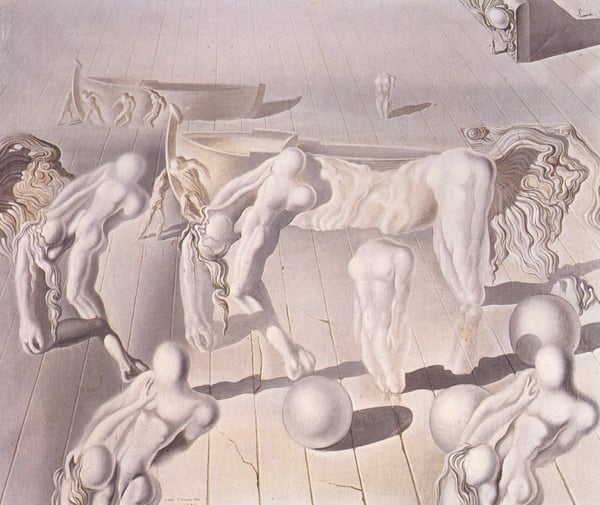
Invisible Sleeping Woman, Horse, Lion
Dettagli
Analisi esperta di Invisible Sleeping Woman, Horse, Lion di Salvador Dali
Stile: Surrealism · Genere: landscape
Expert Art Historical Analysis: Salvador Dalí’s Invisible Sleeping Woman, Horse, Lion (c. 1930)
Dalí’s Invisible Sleeping Woman, Horse, Lion stands as a quintessential example of his paranoiac-critical method, a technique he developed during the Surrealist Period (1929–1940) to destabilize perception and unlock the subconscious. The work is a landscape in genre, yet it subverts traditional landscape conventions by transforming the terrain itself into a psychological stage.
What makes this work significant within Surrealism:
-
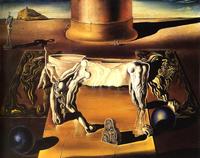
Multiple Image Trompe-l’œil – The title explicitly directs the viewer to see three distinct forms (a sleeping woman, a horse, and a lion) hidden within a single, continuous composition. This is not a collage but a single painted scene, where the contours of rocks, shadows, and barren plains simultaneously read as the sleeping woman’s body, the horse’s neck, and the lion’s mane. Dalí forces the eye to oscillate between these readings, never allowing a stable interpretation. This “invisibility” is the core of the work: the figures are both present and absent, latent in the landscape.
-
Landscape as Psychological Territory – Unlike traditional landscape painting that celebrates nature’s beauty, Dalí’s landscape is a parched, dreamlike desert devoid of life—reminiscent of the Catalan coast he often used. This emptiness becomes a screen onto which unconscious desires are projected. The “invisible sleeping woman” suggests erotic longing (a recurring Dalí motif), while the horse and lion evoke primal instincts. The landscape itself becomes a mental space, a visual metaphor for the dream state where multiple identities coexist.
-
Precursor to Later Late-Work Obsessions – Created in the early 1930s, this painting anticipates Dalí’s later fascination with double images (e.g., The Metamorphosis of Narcissus, Slave Market with the Disappearing Bust of Voltaire). Here, he refines the technique: the figures are not merely “hidden” but emerge from the logic of the scene—the woman’s hair echoes a riverbed, the horse’s mane merges with clouds. This fusion of figure and ground embodies the Surrealist goal of collapsing the boundary between reality and imagination.
Critical Significance:
Invisible Sleeping Woman, Horse, Lion is a landmark of Surrealist ambiguity. It demonstrates Dalí’s ability to make the invisible visible through rigorous composition, while preserving the enigmatic nature of dreams. The work challenges the viewer to become an active participant, decoding the painting as one would a dream—an experience central to the Surrealist revolution in art.
Museum / Gallery
Visivamente simili
20 opere con composizione e palette affini
Invisible Sleeping Woman, Horse, Lion
Salvador Dali
The Font
Salvador Dali
Untitled (Composition - Courtyard of the Escorial with Figure and Sebastian De Morra, Veldzquez's Dwarf)
Salvador Dali
Study for the set of 'Romeo and Juliet'
Salvador Dali
The Dream
Esteban Frances
Enigma (unfinished version of 'The Three Glorious Enigmas of Gala')
Salvador Dali
Paranoiac Woman-Horse (Invisible Sleeping Woman, Lion, Horse)
Salvador Dali
Comets
Sabin Balasa
Thirsty Warrior
Kuzma Petrov-Vodkin
The Tower of Enigmas
Salvador Dali
The Invisible Man
Salvador Dali
The Painter Workshop
Joan Tuset
Dance
Salvador Dali
L’Entracte de l’Apothéose
Leonor Fini
Untitled
Dado
Illumined Pleasures
Salvador Dali
Encounter in the Dawn
Sabin Balasa
Nude on the Plain of Rosas
Salvador Dali
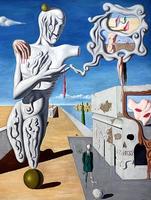
Dolor de mediodía
Angel Planells
A Woman’s Reflection In A Row of Houses
Ernst Fuchs