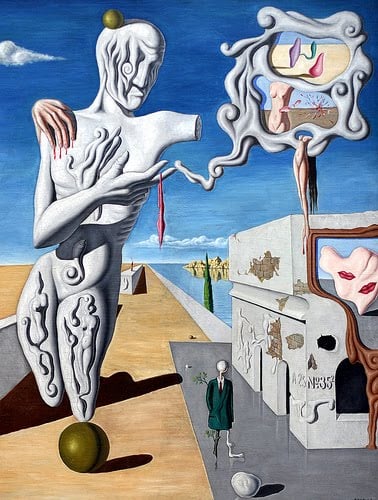
Expert analysis of Angel Planells’s Dolor de mediodía
Style: Surrealism · Genre: symbolic painting
Expert Analysis of "Dolor de mediodía" (Midday Pain) by Angel Planells
Angel Planells, a Catalan painter whose work is often overshadowed by that of his more famous contemporary Salvador Dalí, remains a significant yet underappreciated figure within the Surrealist movement. Dolor de mediodía (Midday Pain) is a quintessential example of how Planells used the Surrealist idiom to explore psychological states through symbolic, dreamlike imagery.
Surrealist Context and Symbolic Language
As a work of Surrealism in the symbolic painting genre, Dolor de mediodía operates on the logic of the subconscious rather than the visible world. The title itself introduces a powerful paradox: "midday" typically connotes brightness, clarity, and the zenith of light, while "pain" (dolor) suggests an interior, emotional darkness. This tension is a hallmark of Surrealist technique—juxtaposing the familiar with the uncanny to generate psychological unease. Planells likely renders a landscape or interior bathed in harsh, noon-day light, yet populated by distorted, irrational objects or figures that signal an inner torment. The "pain" is not physical but existential, a moment of midday stasis where time feels suspended and the mind is exposed to its own anxieties.
Significance within Planells’ Oeuvre and Surrealism
What makes Dolor de mediodía significant is its demonstration of Planells’ distinctive approach to Surrealism. Unlike Dalí’s meticulous, illusionistic dreamscapes, Planells often favored a slightly softer, more atmospheric realism that still retains a charged symbolic force. This painting likely employs typical Surrealist devices—such as melting forms, isolated anatomical fragments, or anomalous shadows—to evoke a state of emotional paralysis. The "midday" setting may reference the Spanish tradition of the siesta hour, a liminal time when reality blurs with dream; Planells transforms this cultural moment into a vehicle for exploring subconscious dread.
Art Historical Relevance
As a lesser-known member of the Catalan Surrealist circle, Planells contributes to the broader narrative of Surrealism beyond the Parisian center. Dolor de mediodía exemplifies how Spanish Surrealists infused the movement with a particular melancholic, metaphysical intensity—what critic Sebastià Gasch called "the poetry of the silent hour." The painting’s symbolic content invites multiple readings: it could represent the unbearable clarity of a repressed memory, the pain of creative stasis, or the existential weight of a world stripped of illusion. In this sense, the work is not merely an exercise in Surrealist technique but a deeply personal meditation on suffering, time, and the fragility of perception.
Conclusion
Dolor de mediodía stands as a compelling instance of Surrealism’s power to render internal conflict through external, symbolic form. Planells’ ability to fuse the specific light of a Mediterranean noon with the ineffable ache of the human condition marks this painting as a significant—if quiet—masterpiece within the Surrealist canon, deserving of recognition for its nuanced psychological depth.
Genre
Style
Visually similar
20 works with related composition and palette
La señora impúdica
Angel Planells
Dona i cap d’home
Angel Planells
Cadavre Exquis (Surrealist Group Collective Work)
Marcelino Vespeira
The Great Masturbator
Salvador Dali
Rhinocerotic Figure of Phidias' Illisos
Salvador Dali
Invisible Sleeping Woman, Horse, Lion
Salvador Dali
The Metamorphosis of the Lovers
Andre Masson
Playing in the Dark
Salvador Dali
Désir d'été
Oscar Dominguez
Surrealist Architecture
Salvador Dali
Female Bather
Salvador Dali
The Lugubrious Game
Salvador Dali
Imperial Monument of Woma-Child. Gala (Utopian Fantasy)
Salvador Dali
Untitled
Ivan Tovar
Le mort de Don Juan
Mario Prassinos
The Rotting Donkey
Salvador Dali
La Lanterne Jaune
Hugues Folloppe
The Sentinel
Desmond Morris
The Bleeding Roses
Salvador Dali
THE WOMAN WITH A KEY
Yervand Kochar