Still Life
Analisi esperta di Still Life di Louis Marcoussis
Stile: Cubism · Genere: sketch and study
Expert Analysis of "Still Life" by Louis Marcoussis
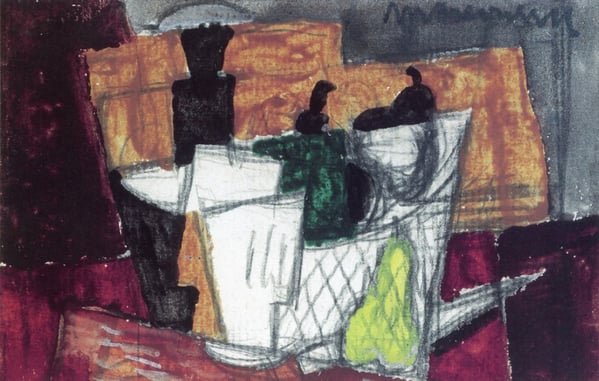
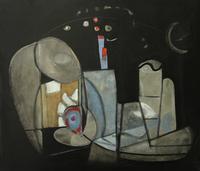
Louis Marcoussis, a Polish-born French painter who became a core member of the Cubist circle, created this Still Life as a sketch and study—a format that reveals the experimental backbone of the Cubist movement. Unlike finished, polished works, a study offers a direct window into the artist’s process of breaking down form, analyzing structure, and testing new spatial relationships. In this context, the artwork’s significance lies in its role as a laboratory for Cubist principles.
Formal Analysis and Cubist Innovations
Marcoussis’s Still Life exemplifies the Cubist drive to dismantle traditional perspective and represent objects from multiple viewpoints simultaneously. The “sketch” aspect likely emphasizes loose, economical lines—perhaps in charcoal or graphite—that delineate the fragmented planes of bottles, glasses, fruit, or a tabletop. These lines do not outline fixed contours; instead, they suggest shifting facets, echoing the analytical phase of Cubism (circa 1909–1912) where form is dissected into intersecting geometric shards. The “study” quality implies a deliberate reduction of color or shading to focus on structure, leaving intervals of blank paper to activate negative space—a hallmark of Cubist composition where emptiness becomes a positive formal element.
Significance Within the Style and Period
-
Documenting Process: As a sketch/study, this work highlights how Cubist artists like Marcoussis worked out their theories on paper before committing to more finished paintings. It preserves the immediacy of thought and the tactile investigation of form, making it a vital document of creative cognition.
-
Bridging Analytical and Synthetic Cubism: Marcoussis often navigated between the two phases. Here, the study’s raw lines may foreshadow the synthetic Cubist move toward flatter, more decorative shapes and the inclusion of text or collage elements. The work thus captures a transitional moment in the movement’s evolution.
-
Personal Contribution: While Picasso and Braque pioneered Cubism, Marcoussis brought a distinct lyricism and subtlety. His studies often retain a softer, more lyrical interplay of curves and angles, as seen in his still lifes of musical instruments or bottles. This Still Life likely reflects his ability to merge cubist abstraction with a lingering sense of everyday reality, making the movement accessible without sacrificing its radical aims.
Conclusion
Still Life by Louis Marcoussis is significant not as a finished statement but as a blueprint of Cubist thinking. It exemplifies how the movement’s revolutionary ideas were first tested in the intimate, unguarded medium of the sketch—where line becomes a tool for redefining space, and a simple study becomes a cornerstone of modern art’s break from representation. This work invites viewers to witness the intellectual and formal energy that drove Cubism forward, confirming Marcoussis’s essential role in shaping one of the most influential styles of the 20th century.
Genere
Stile
Visivamente simili
20 opere con composizione e palette affini
Still Life: Playing Cards, Coffee Cup and Apples
Jean Metzinger
Untitled
Pablo Picasso
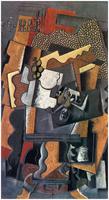
Still Life on a Table
Georges Braque
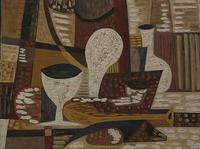
Nature morte à la pipe
Serge Charchoune
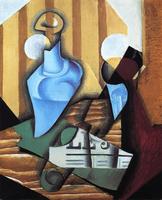
Still Life with Bottle and Glass
Juan Gris
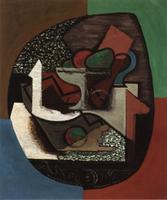
Nimes
Louis Marcoussis
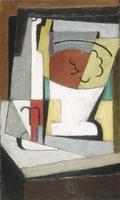
Naturaleza Muerta Cubista
Maria Blanchard
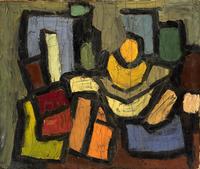
Still Life
William H. Johnson
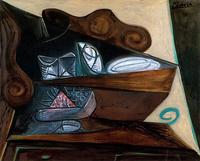
The buffet of 'Catalan'
Pablo Picasso
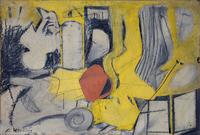
Secretary
Willem de Kooning
Botella Y Frutero Sobre Una Mesa
Maria Blanchard
Untitled
Joan Ponc
Cubist Still Life
Maria Blanchard
Cin-Zin
Karl Knaths
From a High Place II
Arshile Gorky
Naturaleza Muerta Con Tijeras
Maria Blanchard
Bodegón
Maria Blanchard
Naturaleza Muerta Con Copa De Frutas
Maria Blanchard
Untitled
Artin Demirci
nr. 6.130
Fons Heijnsbroek