Analisi esperta di Dawn at Isawa in the Kai province di Katsushika Hokusai
Stile: Ukiyo-e · Genere: landscape
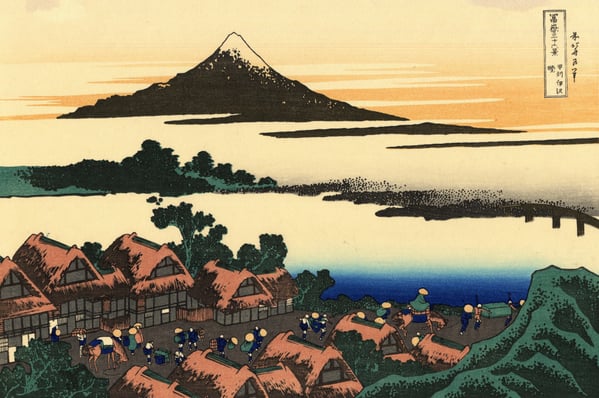
As a standout plate from Katsushika Hokusai’s renowned series Thirty-six Views of Mount Fuji (c. 1830–1832), "Dawn at Isawa in the Kai province" is a masterclass in atmospheric composition and the Ukiyo-e tradition. The print captures the serene yet bustling moment of early morning departure at Isawa, a post station on the Koshu Kaido highway. Visually, Hokusai utilizes a high vantage point to display the textured geometry of the thatched roofs in the foreground, rendered in earthy browns that contrast sharply with the deep, cool blues of the river and the verdant forests. The masterful use of bokashi (color gradation) in the sky—transitioning from the dark band of the horizon to a soft, glowing apricot—perfectly evokes the stillness of dawn breaking over the landscape.
The narrative strength of the artwork lies in its depiction of movement and daily life in Edo-period Japan. While Mount Fuji stands as a dark, stoic silhouette in the distance—anchoring the composition with its eternal presence—the foreground is teeming with the transient activity of human existence. We see travelers and porters preparing for their journey, guiding packhorses laden with goods, their round sedge hats creating a rhythmic pattern along the street. Hokusai’s signature stylization is evident in the pointillist-like rendering of the distant trees and the sharp, clean lines of the bridge on the right, creating a sense of depth that draws the viewer’s eye from the village, across the mist-filled middle ground, and finally to the sacred mountain.
Historically and symbolically, this print embodies the Japanese aesthetic concept of juxtaposing the mundane with the majestic. Hokusai elevates a common scene of transit into a spiritual experience, suggesting that the grandeur of nature (Fuji) is an ever-present backdrop to the hustle of human commerce. The artwork is significant not only for its technical execution—demonstrating the sophisticated woodblock printing capabilities of the era—but also for its documentation of the travel culture of the time. It freezes a fleeting moment of morning light, immortalizing the start of a day’s journey under the watchful gaze of Japan’s most iconic peak.
Museum / Gallery
Visivamente simili
20 opere con composizione e palette affini
Shimomeguro
Katsushika Hokusai
The Tea plantation of Katakura in the Suruga province
Katsushika Hokusai
The Fuji reflects in Lake Kawaguchi, seen from the Misaka pass in the Kai province
Katsushika Hokusai
Landscape with two falconers
Katsushika Hokusai
Hodogaya, Shinkame Bashi, Station 5
Hiroshige
Fuji from Mizuchubo
Shotei Takahashi
Lake Suwa in the Shinano province
Katsushika Hokusai
Moonlight over the Sumida River in Edo
Katsushika Hokusai
Enoshima in the Sagami province
Katsushika Hokusai
Tea house at Koishikawa. The morning after a snowfall
Katsushika Hokusai
The Fuji seen from the gay quarter in Senju
Katsushika Hokusai
Spring View of Mount Fuji
Asano Takeji
View of Mt. Fuji
Utagawa Kuniyoshi
View of the beach at low tide Noboto from the coast to Gyôtoku
Katsushika Hokusai
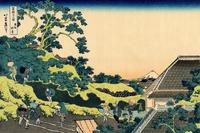
The Fuji seen from the Mishima pass
Katsushika Hokusai
84. Grandpa's Teahouse in Meguro
Hiroshige
96. Horie and Nekozane
Hiroshige
Mariko Mabutsu Chaya
Hiroshige
Snow Dawn at Susaki
Hiroshige
Mount Fuji from Narusawa in Autumn
Hasui Kawase