Analisi esperta di Enoshima in the Sagami province di Katsushika Hokusai
Stile: Ukiyo-e · Genere: landscape
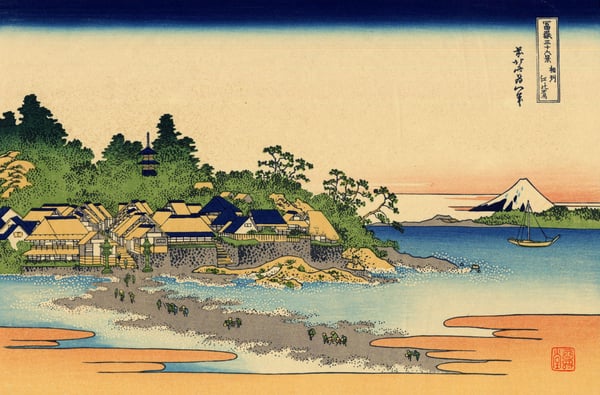
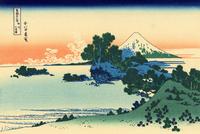
In this serene plate from the celebrated series Thirty-six Views of Mount Fuji, Katsushika Hokusai captures the lush, verdant topography of Enoshima, a tidal island dedicated to the goddess Benzaiten. The composition is dominated by the island itself, rendered with an intricate, stippled technique—a profusion of dots—that suggests dense foliage and ancient forests. This stylistic choice contrasts sharply with the geometric lines of the village rooftops and the torii gate at the island's entrance, creating a harmonious dialogue between the organic chaos of nature and human architectural order. The exposed sandbar, revealed by the low tide, creates a natural leading line that draws the viewer’s eye from the bottom left into the heart of the sacred island, following the path of the tiny, animated pilgrims.
The print is a masterclass in the use of bokashi (color gradation) and the then-revolutionary Prussian Blue pigment, visible in the deep, rich gradients of the water and the sky. The ocean is depicted not as a terrifying force, as seen in Hokusai's "Great Wave," but as a rhythmic, textured expanse of white-capped wavelets that gently lap against the shore. Crucially, Mount Fuji sits quietly in the background on the right, framed by the horizon. While it is the titular subject of the series, here it serves as a distant, spiritual anchor, emphasizing that the holy ground of Enoshima is part of a larger, sacred geography.
Historically, this work captures the essence of the Edo period's "Floating World" (Ukiyo-e) by documenting the booming culture of domestic travel and pilgrimage. Enoshima was a popular destination for Edoites, offering a mix of religious devotion and leisure. Hokusai portrays this duality perfectly; the figures crossing the sandbar are a mix of travelers and devotees, highlighting the intersection of the sacred and the secular. The artwork stands as a testament to Hokusai’s ability to elevate a simple travel guide visual into a meditation on the relationship between humanity, the divine, and the enduring power of the landscape.
Visivamente simili
20 opere con composizione e palette affini
View of Mt. Fuji
Utagawa Kuniyoshi
Moonlight over the Sumida River in Edo
Katsushika Hokusai
Snow Dawn at Susaki
Hiroshige
Unuma, pl. 53 from a facsimile edition of Sixty-nine Stations of the Kiso Highway
Keisai Eisen
A Snowstorm at Kinryozan Temple
Utagawa Kuniyoshi
The Fuji reflects in Lake Kawaguchi, seen from the Misaka pass in the Kai province
Katsushika Hokusai
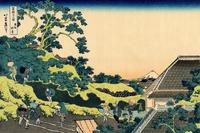
The Fuji seen from the Mishima pass
Katsushika Hokusai
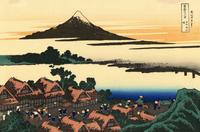
Dawn at Isawa in the Kai province
Katsushika Hokusai
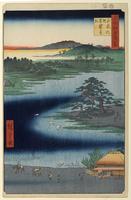
110. Robe Hanging Pine at Senzoku No Ike
Hiroshige
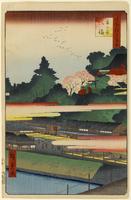
41. Hachiman Shrine in Ichigaya
Hiroshige
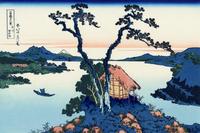
Lake Suwa in the Shinano province
Katsushika Hokusai
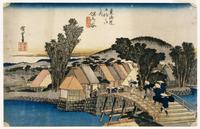
Hodogaya, Shinkame Bashi, Station 5
Hiroshige
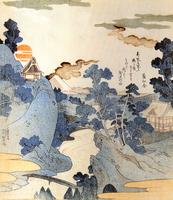
View of Mt. Fuji
Utagawa Kuniyoshi
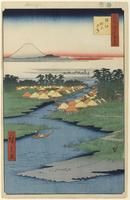
96. Horie and Nekozane
Hiroshige
The Castle of Unuma
Keisai Eisen
Shimomeguro
Katsushika Hokusai
The fifty three stations of the Tokaido
Utagawa Kuniyoshi
9. Yatsukōji, Inside Sujikai Gate
Hiroshige
54 (66) The Benkei Moat from Soto Sakurada to Kōjimachi
Hiroshige
Shichiri beach in Sagami province
Katsushika Hokusai