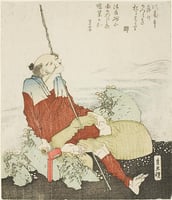
Expertenanalyse zu Katsushika Hokusais Manga
Stil: Ukiyo-e · Genre: sketch and study
Expert Analysis of "Manga" by Katsushika Hokusai
As an Ukiyo-e artist, Katsushika Hokusai is renowned for his iconic woodblock prints such as The Great Wave off Kanagawa, but his Manga series represents a revolutionary expansion of the genre beyond narrative prints into a spontaneous, encyclopedic study of life itself. The "Manga" — a term Hokusai coined, meaning "whimsical sketches" or "random drawings" — is a multi-volume collection (beginning in 1814) that transcends the typical boundaries of Ukiyo-e, which often focused on courtesans, kabuki actors, and scenic views.
Significance within Ukiyo-e and the Sketch Genre
-
A Living Lexicon of Form and Motion
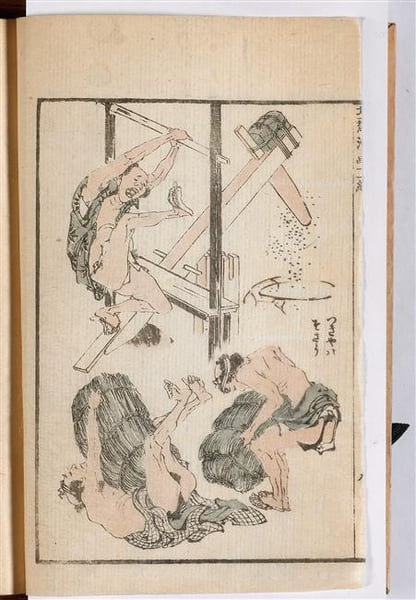
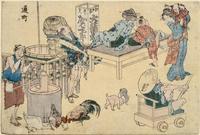
Hokusai’s Manga is a masterclass in observation. Unlike polished Ukiyo-e prints intended for commercial sale, these sketches capture raw, unposed moments: peasants at work, animals in action, waves curling, and figures contorted in extreme postures. This emphasis on kinetic energy and everyday life broke from the idealized, static compositions common in earlier Ukiyo-e, anticipating the modern interest in "sketching from life" that would later influence European Impressionists. -
Encyclopedic Range and Humanist Vision
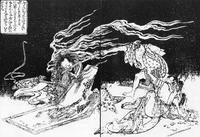
The series contains over 4,000 drawings covering everything from Buddhist deities and mythical creatures (like dragons and oni demons) to detailed studies of architecture, tools, and the natural world (birds, fish, insects). This breadth reflects Hokusai’s belief that drawing is a tool for understanding the universe—a proto-scientific yet deeply artistic approach. The Manga essentially functions as a visual encyclopedia of early 19th-century Japanese life and imagination. -
Pioneering a New Genre: The Sketchbook as Art
Before Hokusai’s Manga, sketchbooks were private artist’s tools. Hokusai published them as finished works, elevating the sketch to a respected art form. This democratization of drawing—raw, humorous, and accessible—directly influenced the development of manga as a sequential narrative art in 20th-century Japan and inspired Western artists like Vincent van Gogh and Edgar Degas, who praised the Manga for its vitality and economy of line. -
Technical Innovation in Line and Composition
Hokusai employed a bold, dynamic line—often thick and calligraphic—to suggest volume and movement without shading. His use of negative space and surprising cropped compositions (a figure cut off by the frame) presaged modern comic-book paneling. This technique allowed him to pack immense detail into small vignettes while maintaining visual clarity, a hallmark of the Manga’s influence on later graphic storytelling.
In essence, Manga is significant not as a single artwork but as a foundational project that redefined Ukiyo-e by liberating it from commercial constraints, celebrating the spontaneity of the sketch, and creating a visual grammar that would ripple through both Eastern and Western art history. Hokusai’s Manga is the bridge between traditional Japanese woodblock prints and the global language of modern illustration.
Museum / Gallery
Visuell ähnlich
20 Werke mit ähnlicher Komposition und Farbpalette
Manga
Katsushika Hokusai
Street scenes newly pubished
Katsushika Hokusai
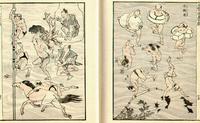
Images of Bathers (Bathing People)
Katsushika Hokusai
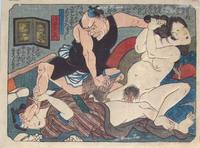
The fight
Utagawa Kunisada
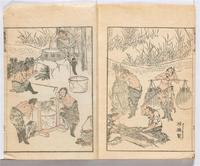
Manga
Katsushika Hokusai
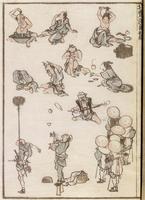
Manga
Katsushika Hokusai
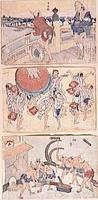
Street scenes newly pubished
Katsushika Hokusai
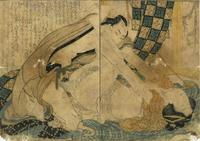
The Adonis plant
Katsushika Hokusai
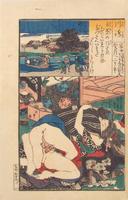
Tokaido 53 Stations, Station #2, Shinagawa
Utagawa Kunisada
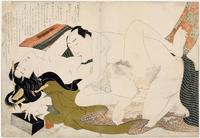
Models Hugs
Katsushika Hokusai
Sumo wrestlers
Ogata Gekko
Heroes of china and Japan
Utagawa Kuniyoshi
The Adonis plant
Katsushika Hokusai
Tokaido 53 Stations, Station #44, Yokkaichi
Utagawa Kunisada
Woman
Katsushika Hokusai
Rape scene
Utagawa Kuniyoshi
Street scenes newly pubished
Katsushika Hokusai
Vengeful ghost that manifests in physical (rather than spectral) form
Katsushika Hokusai
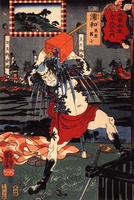
Urawa
Utagawa Kuniyoshi
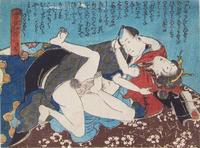
The Brown Futon
Utagawa Kunisada