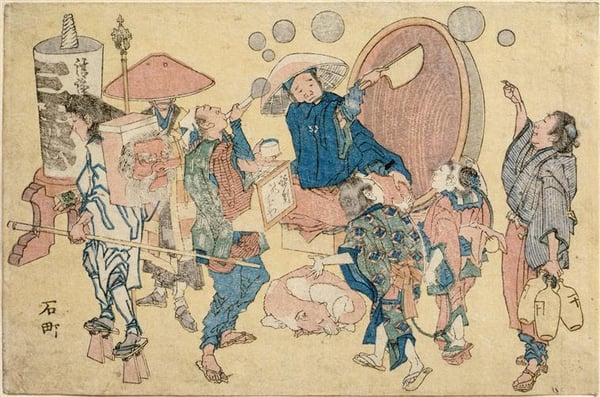
Analisi esperta di Street scenes newly pubished di Katsushika Hokusai
Stile: Ukiyo-e · Genere: genre painting
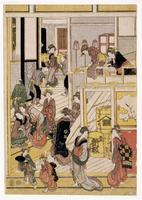
Expert Analysis of Katsushika Hokusai’s Street Scenes Newly Published
Style & Period Context
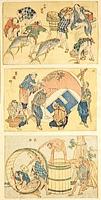
As an ukiyo-e (“pictures of the floating world”) genre painting, this work belongs to the nikuhitsu (hand-painted) or woodblock print tradition that flourished during Japan’s Edo period (1603–1868). Hokusai, best known for his later Thirty-six Views of Mount Fuji (including The Great Wave off Kanagawa), was a master of capturing the vitality of urban life. Street Scenes Newly Published exemplifies his commitment to documenting the mundane with precision and dynamism, a hallmark of ukiyo-e’s shift from idealized beauties and actors to the everyday world.
Significance Within Hokusai’s Oeuvre
- Innovative Perspective & Composition: Hokusai frequently experimented with Western linear perspective and unusual cropping, influences absorbed from imported Dutch engravings. In this work, he likely employs a low vantage point or dramatic diagonals to draw viewers into the bustling street, creating a sense of immediacy and depth that was revolutionary for Japanese printmaking.
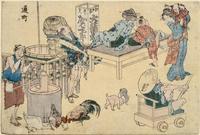
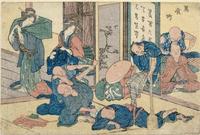
- Narrative Density: True to the “genre painting” classification, the scene is packed with anecdotal detail—vendors, pedestrians, children, and laborers interacting in a tightly woven composition. Hokusai’s keen observation of posture, gesture, and costume reveals social hierarchies and daily rituals, offering a documentary snapshot of Edo-period common life.
- Woodblock Technique: The title “newly published” suggests this was part of a series or an immediate success in the publisher’s catalogue. Hokusai’s skillful use of bokashi (gradation) and crisp keyagaki (hairline) lines would have enlivened the prints, making the street feel almost tactile.
Artistic Legacy
Street Scenes Newly Published represents Hokusai’s enduring contribution to ukiyo-e: elevating lowly street scenes to fine art through compositional rigor and humanist warmth. It prefigures the meisho-e (famous places) genre while retaining the intimacy of fūzokuga (genre pictures). This work, like much of Hokusai’s output, influenced later Western artists—from Degas’s candid street views to van Gogh’s Courtesan (after Hokusai)—cementing its significance as a bridge between Japanese vernacular imagery and global modernism.
Museum / Gallery
Visivamente simili
20 opere con composizione e palette affini
Street scenes newly pubished
Katsushika Hokusai
People stopping to admire the gourd that miraculously appeared at the time of the birth of Prince Shôtoku
Utagawa Kuniyoshi
Street scenes newly pubished
Katsushika Hokusai
Street scenes newly pubished
Katsushika Hokusai
Actor Ichikawa Ebijuro, seated on floor with shamisen at his feet
Utagawa Toyokuni
The Ghosts of Togo and His Wife
Utagawa Kuniyoshi
Shower
Kitagawa Utamaro
The Promenade
Utagawa Toyokuni
Street scenes newly pubished
Katsushika Hokusai
Kuwana
Katsushika Hokusai
Daizo the Substitute
Tōshūsai Sharaku
Manga
Katsushika Hokusai
Manga
Katsushika Hokusai
The seven gods of good fortune
Utagawa Kuniyoshi
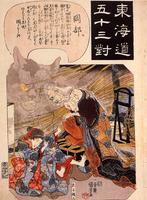
Okabe - The cat witch
Utagawa Kuniyoshi
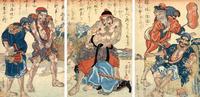
Suikoden Triptych the Fishermen
Utagawa Kuniyoshi
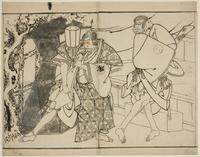
Arashi Ryūzō and Morita Kan'ya VIII
Tōshūsai Sharaku
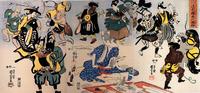
Otsu-e Paintings Coming Alive Triptych
Utagawa Kuniyoshi
New Year's Days of the Teahouse Ogi-ya
Katsushika Hokusai
Along the Shore of Yènoshim
Kitagawa Utamaro