
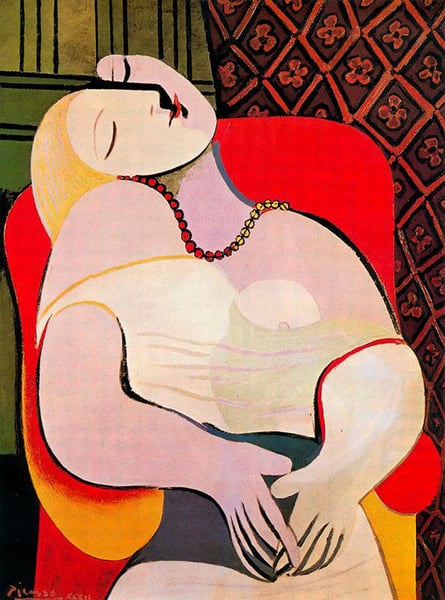
A dream
Détails
Analyse experte de A dream de Pablo Picasso
Style : Cubism · Genre : portrait
Expert Analysis: "A Dream" by Pablo Picasso
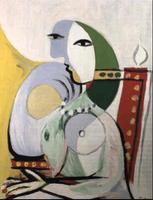
Painted during Picasso’s Neoclassicist & Surrealist Period (roughly 1917–1937), A Dream (often known as Le Rêve, 1932) is a landmark portrait that fuses the structural innovations of Cubism with the psychological depth of Surrealism. Although the work is primarily identified with Picasso’s Surrealist explorations, its formal vocabulary remains deeply indebted to Cubist principles.
Significance within Cubism and the Neoclassicist & Surrealist Period
-
Cubist Portrait Innovation: The painting exemplifies how Picasso continued to use Cubist fragmentation even after the movement’s high phase. The sitter—his young mistress Marie-Thérèse Walter—is depicted with a radically simplified, faceted face: one eye is closed in sleep, the other open and staring, a clear Cubist disjunction that collapses multiple viewpoints into a single plane. The body is rendered in soft, curving, yet angular contours, merging the analytical order of Cubism with a more fluid, dreamlike geometry.
-
Surrealist Dream Imagery: True to its title, the artwork captures the subconscious state of dreaming. The sweeping, biomorphic curves of the chair and the figure’s arms echo Surrealist automatism, while the intense, almost hallucinatory color palette—vivid reds, blues, and yellows—heightens the emotional, erotic charge. The famous “split” face (half in light, half in shadow) visually literalizes the division between waking and sleeping consciousness.
-
Neoclassical Influence: Despite its Surrealist content, the composition retains a neoclassical sense of monumentality. The figure fills the canvas with classical gravity, and the simplified, sculptural forms recall Picasso’s earlier Ingres-inspired portraits. This synthesis of classical grandeur, Cubist structure, and Surrealist subject matter makes A Dream a quintessential work of Picasso’s transitional period, bridging his post-war classicism with his later, more overtly Surrealist imagery.
Legacy and Impact
A Dream is celebrated not only for its technical mastery—bold color blocks, rhythmic line, and ingenious distortion—but also for its deeply personal symbolism. It immortalizes Marie-Thérèse as an icon of feminine mystery and desire, while demonstrating how Cubism could be adapted to express modern psychological states. The work’s ability to reconcile rigorous formal experimentation with raw, emotional intimacy marks it as a pivotal achievement in Picasso’s career and a touchstone of 20th-century portraiture.
Museum / Gallery
Visuellement similaire
20 œuvres à la composition et à la palette proches
Female nude sitting in red armchair
Pablo Picasso
Reading
Pablo Picasso
Portrait of Marie-Thérèse Walter
Pablo Picasso
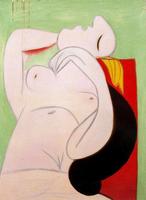
Sleep
Pablo Picasso
Woman with a Cat
Fernand Leger
Woman with yellow hair
Pablo Picasso
Woman sitting in blue armchair
Pablo Picasso
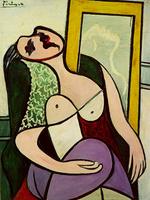
Girl in front of mirror
Pablo Picasso
Woman sitting in an armchair
Pablo Picasso
Woman with book
Pablo Picasso
Lovers (The Hembusses)
Ernst Ludwig Kirchner
Žena v křesle s knihou
Emil Filla
Woman with Pineapple
Rufino Tamayo
Queen of Hearts
Willem de Kooning
Couple 2
Richard Lindner
Mulata no sofá
Emiliano Di Cavalcanti
Seated woman
Pablo Picasso
Scheiber Hugó, Höllgy Sállal,
Scheiber Hugó
Reclining Female Nude
Ernst Ludwig Kirchner
Seated female nude
Pablo Picasso