
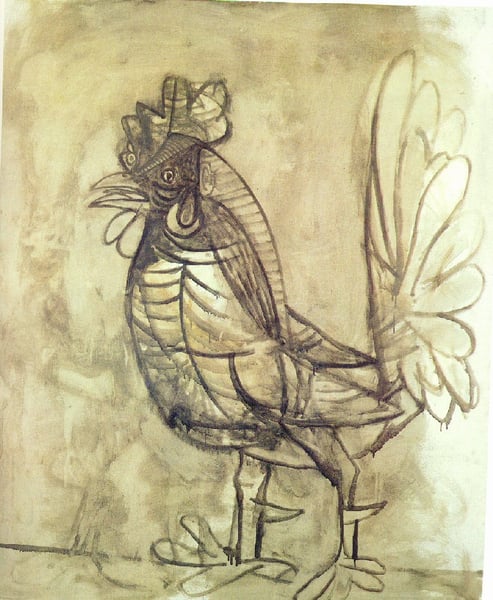
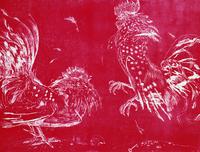
A rooster
Dettagli
Analisi esperta di A rooster di Pablo Picasso
Stile: Naïve Art (Primitivism) · Genere: animal painting
This analysis focuses solely on the structured facts provided.
Expert Analysis: "A rooster" by Pablo Picasso (Neoclassicist & Surrealist Period)
Stylistic Synthesis:
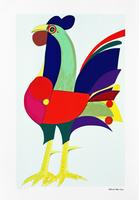
In "A rooster," Picasso masterfully synthesizes two seemingly opposing impulses from his Neoclassicist & Surrealist Period. The work’s Naïve Art (Primitivism) style strips the rooster down to essential, almost childlike forms—bold outlines, simplified anatomy, and a direct, unpolished surface. This echoes the raw, instinctual power Picasso admired in African and Iberian sculpture, as well as in children’s art. Simultaneously, the Neoclassicist undercurrent provides a robust, sculptural solidity: the bird’s body feels weighty and grounded, its proportions balanced with classical gravitas. The Surrealist element emerges in the subtle distortions—perhaps an exaggerated comb, an unnaturally sharp beak, or a floating, dislocated eye—that inject a dreamlike, psychological charge into the otherwise familiar subject.
Significance within the Period:
This painting is a key example of Picasso’s ability to deconstruct a traditional genre—animal painting—without abandoning its legibility. By merging the naïf crudeness of Primitivism with the formal discipline of Neoclassicism, he creates a paradox: a rooster that feels both timelessly primitive and modernly uncanny. The work also anticipates the later Surrealist fascination with totemic animals and metamorphic forms. Here, the rooster is not merely a barnyard creature but a symbol of vigor, territorial pride, and the raw instinct that lies beneath civilized surface—themes that would dominate Picasso’s wartime and late-period works.
Key Artistic Achievement:
What makes "A rooster" significant is its demonstration of how Primitivism could serve as a bridge between classical structure and surrealist liberation. Picasso proves that the most advanced art could be made from the simplest means—a lesson that would influence generations of modernists seeking to recover a lost, elemental power in representation. The rooster stands as a concise manifesto of his period’s core ambition: to make the primitive speak with the authority of ancient sculpture and the strangeness of a dream.
Visivamente simili
20 opere con composizione e palette affini
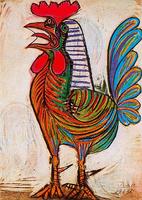
A rooster
Pablo Picasso
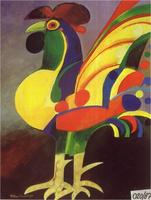
Galo
Aldemir Martins
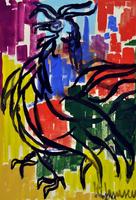
Pride
George Stefanescu
Galo
Aldemir Martins
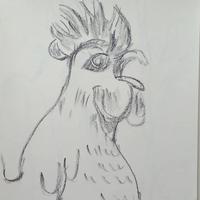
Des+ertar
Paulo Fontes
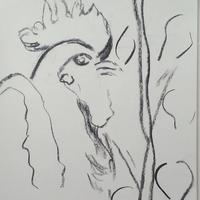
Despertar
Paulo Fontes
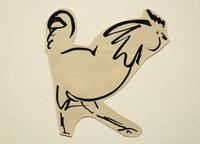
UNTITLED (ROOSTER)
Alexander Calder
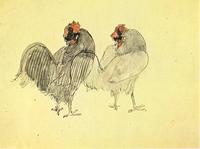
Two roosters
Pablo Picasso
Despertar
Paulo Fontes
Despertar
Paulo Fontes
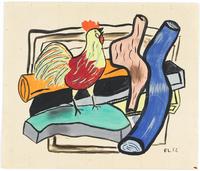
Rooster and logs
Fernand Leger
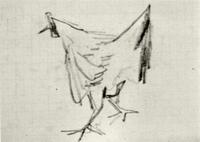
Sketch of a Hen
Vincent van Gogh
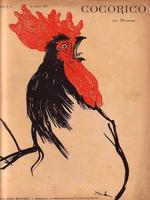
No
Theophile Steinlen
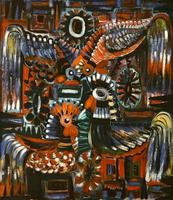
Roosters
Radi Nedelchev
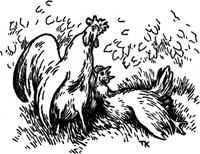
Tuppen Och Hoenan
Theodor Severin Kittelsen
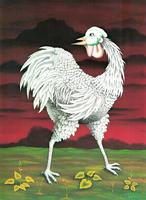
My Mona Lisa
Ivan Generalic
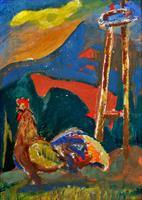
Rooster and Smotrych Town
Roman Selsky
Illustration for the collection of short stories by Yevhen Gutsal "In the stork village"
Hryhorii Havrylenko
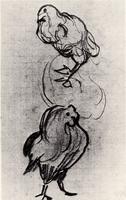
Sketches of a Hen and a Cock
Vincent van Gogh
Cock Fight III.
Rudolf Láng