
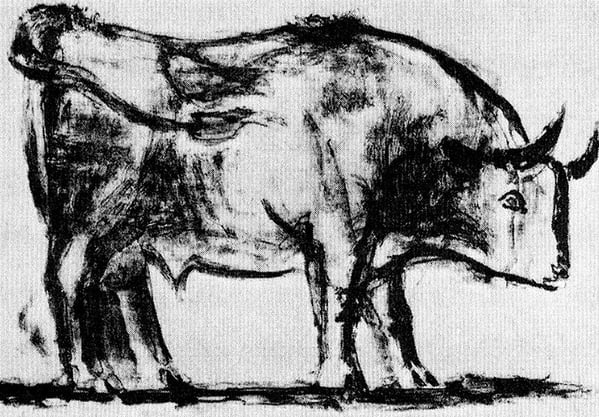
Bull (plate I)
Dettagli
Analisi esperta di Bull (plate I) di Pablo Picasso
Stile: Expressionism · Genere: animal painting
Expert Analysis: "Bull (plate I)" by Pablo Picasso
Pablo Picasso’s Bull (plate I) stands as a compelling example of his ability to synthesize multiple stylistic currents within a single, seemingly straightforward animal painting. According to the structured facts provided, the work belongs to the Neoclassicist & Surrealist Period while employing the expressive distortions characteristic of Expressionism. This fusion is what makes the piece particularly significant: it captures a transitional moment in Picasso’s career when he was exploring the tension between classical discipline and raw, emotional force.
Expressionist Energy The designation as Expressionism is crucial here. Rather than pursuing naturalistic representation, Picasso distorts the bull’s form to convey its raw power and primal intensity. Bold, sinuous lines exaggerate the animal’s musculature, horn curvature, and aggressive stance. The thick, almost brutal contours and the compression of space charge the image with a visceral energy that goes beyond mere depiction—it is a psychological portrait of the bull as a symbol of vitality, threat, and earthy instinct.
Neoclassicist & Surrealist Overtones Despite its expressionist handling, the work is rooted in the structural clarity of Neoclassicism. The composition is balanced, the bull’s silhouette is monumental and sculptural, recalling the simplified forms of archaic Greek or Roman art. This classical sense of order contrasts with the Surrealist element: the bull becomes a dreamlike emblem of subconscious drives. Picasso, having recently emerged from his Surrealist period, often used animal motifs (bulls, minotaurs, horses) to explore themes of violence, mythology, and human nature. In Bull (plate I), the animal appears as both a real creature and a timeless archetype—a hybrid of mythic beast and living presence.
Significance within Its Period Created during Picasso’s Neoclassicist & Surrealist phase (c. 1918–1930s), this work exemplifies his search for a universal, iconic language. The bull is not merely an animal; it is a vehicle for exploring form, expression, and symbolism. It anticipates Picasso’s later, more abstracted bull series (the 1945–46 lithographs) but retains a greater sense of monumentality and direct emotional impact. By merging the raw spontaneity of Expressionism with the structural rigor of Neoclassicism and the dreamlike resonance of Surrealism, Bull (plate I) becomes a microcosm of Picasso’s artistic thesis: art can be both ancient and immediate, both felt and thought.
In the context of animal painting, it elevates the genre from decorative study to a profound statement about life, power, and the artist’s own Spanish heritage—the bull as an emblem of Spain itself. This combination of stylistic influences and layered meaning secures Bull (plate I) as a significant marker of Picasso’s evolution and his enduring fascination with the primal essence of form.
Museum / Gallery
Visivamente simili
20 opere con composizione e palette affini
Bull (plate III)
Pablo Picasso
Sunday Afternoon
Elaine de Kooning
Composition (The Cow)
Theo van Doesburg
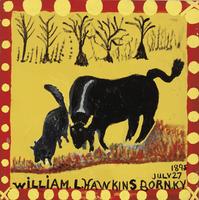
Steer and Dog
William Hawkins
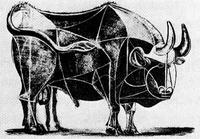
Bull (plate IV)
Pablo Picasso
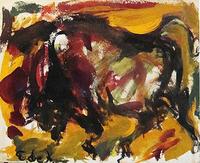
Standing Bull
Elaine de Kooning
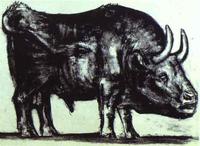
Bull (plate II)
Pablo Picasso
Foolishness of the Fools
Francisco Goya
Untitled (Bull)
Elaine de Kooning
Bulls
Viorel Marginean
Magic Wall
Elaine de Kooning
Andalusian Bulls
Rosa Bonheur
Bull
Steve Kaufman
Bull (plate V)
Pablo Picasso
Bull I
Bertalan Por
Suite Toros
Joan Ponc
Taureau Cabre
Antoine-Louis Barye
Texas Pride
Russ Warren
Abstraction (Standing Bull)
Elaine de Kooning
The Cow With The Subtle Nose
Jean Dubuffet