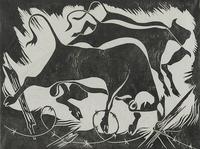
Expert Analysis: Bull (plate IV) by Pablo Picasso
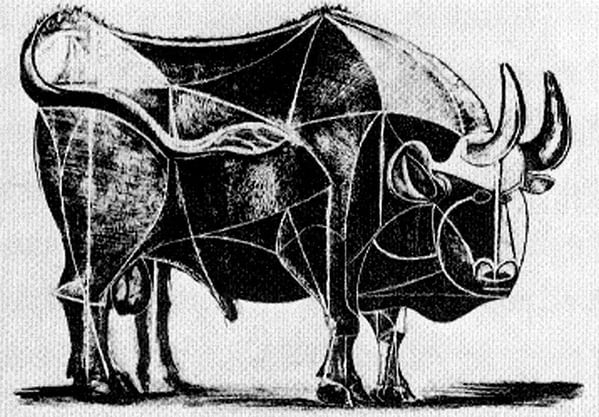
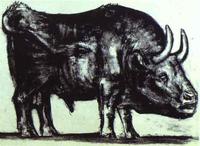
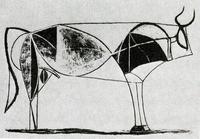
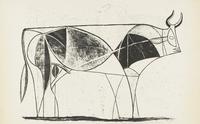
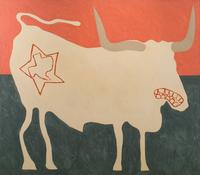
This work, executed during Picasso’s Neoclassicist & Surrealist Period, is a seminal example of how Cubist principles—specifically the reduction of form to its most elemental geometric and linear components—can be applied to the animal-painting genre. While Picasso’s earlier Cubist works fractured objects into multiple facets, Bull (plate IV) pushes the logic of structural simplification to a radical extreme: the bull is distilled to a single, unbroken contour line that simultaneously defines its silhouette and internal anatomy.
Significance within Cubism: Here, analysis and synthesis are compressed into a singular, calligraphic gesture. The image achieves maximum expressive power with minimal means—a hallmark of Picasso’s mature engagement with Cubist abstraction. The bull’s mass is suggested not by shading or perspective but by the tension between the outline and the negative space around it, demonstrating Cubism’s enduring concern with the relationship between object and ground.
Period context: Created during his Neoclassicist & Surrealist Period, the work bridges two impulses. The discipline of the single line recalls the classical economy of line drawing (a Neoclassicist trait), while the transformation of a living animal into a near-abstract symbol resonates with Surrealism’s interest in primal archetypes and the subconscious. The bull—a recurring motif in Picasso’s œuvre—becomes a totemic figure, both specific and universal.
Genre innovation: As an animal painting, Bull (plate IV) redefines the genre. Instead of naturalistic depiction, Picasso offers an essence: the bull’s power, its mass, its iconic horned profile. This is significant as a pure example of “analytic” Cubist logic applied to a single continuous line, predating and influencing later minimalist and conceptual approaches to animal representation. The work stands as a masterclass in how reduction can amplify meaning—a lesson that continues to inform modern visual culture.