
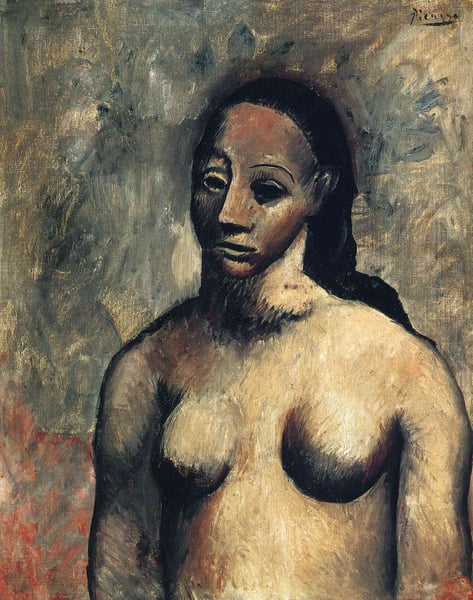
Expert analysis of Pablo Picasso’s Bust of nude woman
Style: Expressionism · Genre: nude painting (nu)
Expert Analysis: "Bust of Nude Woman" (c. 1907) – Pablo Picasso
This work belongs to Picasso’s African Period (1907–1909), a brief but transformative phase that immediately preceded and directly informed the development of Cubism. The painting is a powerful example of how Picasso synthesized the raw, angular forms of African tribal masks with the expressive distortion of early Expressionism, creating a radically new language for the human figure.
Formal Innovations & African Influence
The figure’s face is rendered with the stark, mask-like geometry characteristic of this period: bulging, asymmetrical eyes, a flattened nose, and ears reduced to simple arcs. The brushwork is aggressive and fractured, with bold outlines and earthy, muted tones (ochres, browns, blacks) that strip the nude of idealized sensuality. Instead of soft modeling, Picasso uses harsh, angular planes that literally “carve” the body out of the canvas, resembling carved wood or stone fetishes from West and Central Africa.
Proto-Cubist Structure
The bust is not a naturalistic portrait but a structural reassembly of the female form. The neck and shoulders are reframed as interlocking geometric segments—cylinders, wedges, and faceted blocks—foreshadowing the analytical deconstruction of space Picasso would pursue just a year later in works like Bread and Fruit Dish on a Table (1909). The figure’s right eye is significantly larger than the left, a visual dissonance that disrupts single-point perspective and hints at multiple viewpoints simultaneously.
Significance in the African Period
This painting stands as a direct companion to Picasso’s revolutionary Les Demoiselles d’Avignon (1907). While the Demoiselles shocked with its aggressive, fragmented female nudes, “Bust of Nude Woman” concentrates that same energy into a single, monumental head-and-shoulders composition. Here, Picasso moves beyond mere stylistic borrowing: he adopts the non-Western aesthetic principle of conceptual rather than perceptual representation—the face is not what is seen, but what is known or felt, imbued with ritualistic power.
Legacy
The work marks a crucial step in the death of classical beauty and the birth of a modernist primitivism that would influence German Expressionists and, later, the entire trajectory of 20th-century abstraction. Its significance lies in its aggressive refutation of Renaissance harmony, replacing it with a fractured, emotive, and culturally syncretic vision of the human figure that remains jarring and vital.
Visually similar
20 works with related composition and palette
Seated nude
Amedeo Modigliani
Nude
Rene Magritte
Portrait of Nusch Éluard
Pablo Picasso
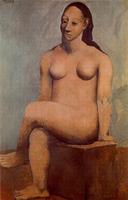
Seated nude with her legs crossed
Pablo Picasso
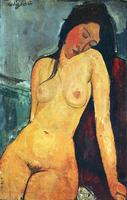
Seated female nude
Amedeo Modigliani
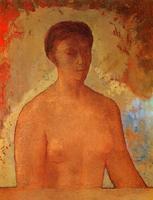
Eve
Odilon Redon
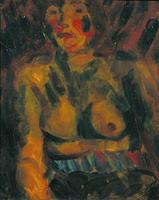
Half Length Nude
Matthew Smith
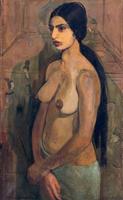
Self Portrait as Tahitian
Amrita Sher-Gil
Bela Czobel, Nu Assis 1928
Bela Czobel
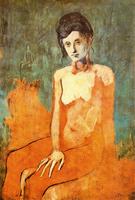
Seated female nude
Pablo Picasso
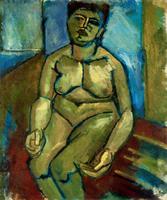
Seated nude
Raoul Dufy
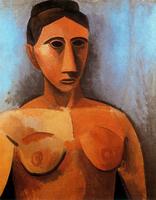
Female bust
Pablo Picasso
Female Nude
Yiannis Moralis
Nude (Black and Gold)
Henri Matisse
Torso the Idol
Kees van Dongen
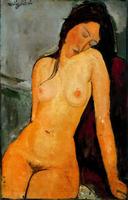
Female nude
Amedeo Modigliani
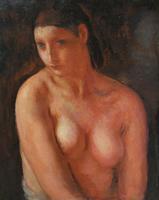
Bust de jeune fille
Michel Simonidy
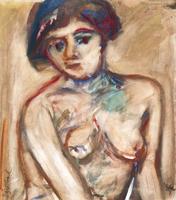
Czóbel Béla Nude
Bela Czobel
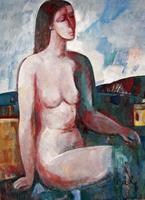
Nude
Rudolf Bér
Nu sur fond bleu
Marcelle Cahn