
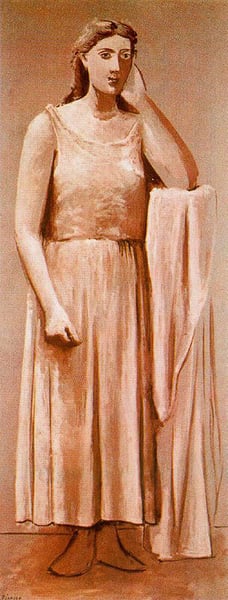
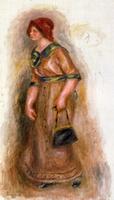
Greek woman
Dettagli
Analisi esperta di Greek woman di Pablo Picasso
Stile: Neoclassicism · Genere: portrait
Expert Analysis: "Greek Woman" by Pablo Picasso (c. 1920s)
During his Neoclassicist & Surrealist Period (roughly 1918–1927), Pablo Picasso produced a striking series of works that consciously rejected the fragmentation of Cubism in favor of a monumental, serene classicism. "Greek Woman" is a landmark example of this "return to order," embodying the artist’s deep engagement with Mediterranean antiquity while simultaneously foreshadowing the dreamlike distortions that would define his Surrealist output.
Significance in Style and Period
-
Neoclassical Revival: The painting’s genre—a portrait—is treated with a sculptural weight reminiscent of ancient Greek kore figures or Roman frescoes. Picasso simplifies the woman’s features into broad, rhythmic planes, while her gown and headdress echo classical drapery. This deliberate archaism reflects Picasso’s interest in Ingres, Renoir’s late bathers, and the antique sculpture he studied during his 1917 trip to Rome and Naples.
-
Dialectic with Surrealism: Even within this Neoclassical guise, the work contains surrealist tensions. The figure’s monumental stillness feels almost uncanny; her eyes may be slightly uneven or too large, and the background is a flattened, abstracted space. Picasso was already corresponding with the Surrealists, and "Greek Woman" demonstrates how he could make classical order feel psychologically charged—a precursor to the biomorphic forms of his later Surrealist paintings.
-
Contrast with Cubism: After years of fractured geometries, this portrait asserts a unified, simplified silhouette. Yet Picasso does not abandon modernity: the firm contours and earthy palette (ochre, terracotta, white) are not imitative of antiquity but reinterpreted through a modern lens. The woman’s monumental presence is both timeless and distinctly 20th-century.
Why It Matters
"Greek Woman" encapsulates Picasso’s ability to synthesize contradictory impulses—order and dream, tradition and avant-garde. It stands as a key transitional work, proving that Neoclassicism was not a regressive step but a fertile ground for Picasso’s ongoing exploration of form, identity, and myth. In art history, it remains a powerful example of how modernism could embrace the classical without sacrificing its radical edge.
Museum / Gallery
Visivamente simili
20 opere con composizione e palette affini
Seated woman
Pablo Picasso
A standing woman
William-Adolphe Bouguereau
Seated woman
Pablo Picasso
Study for Vicomtesse d'Hausonville, born Louise Albertine de Broglie I
Jean Auguste Dominique Ingres
Henriette Harvey and her half sister Elizabeth Norton
Jean Auguste Dominique Ingres
Woman in white
Pablo Picasso
Physionomies Parisiennes: Petit Commerce. La Monnaie d'un Ballon
Paul Gavarni
Poplar (Illustration to Taras Shevchenko's poem Poplar?)
Hryhorii Havrylenko
Desdemona
Dante Gabriel Rossetti
Study of seated woman
Jean Auguste Dominique Ingres
Leaning woman with bonnet
Pablo Picasso
STUDY OF A YOUNG WOMAN HER ARM RESTING ON A BOOK HOLDING A COMPASS IN HER RIGHT HAND
Ginevra Cantofoli
The Greek Slave Girl (or Variations in Violet and Rose)
James McNeill Whistler
Study for Raphael and the Fornarina
Jean Auguste Dominique Ingres
Agar and Ismaël in the desert
François-Joseph Navez
Self Portrait Undressed
Émilie Charmy
Seated woman
Pablo Picasso
Ferenczy Károly, Vidéki Szinésznő 1913
Karoly Ferenczy
Pierreuse
Theophile Steinlen
Woman with Bag
Pierre-Auguste Renoir