
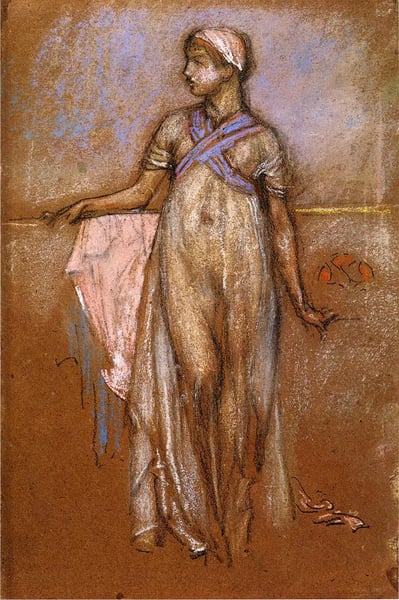
The Greek Slave Girl (or Variations in Violet and Rose)
Dettagli
Analisi esperta di The Greek Slave Girl (or Variations in Violet and Rose) di James McNeill Whistler
Stile: Symbolism · Genere: portrait
Expert Art Historical Analysis: "The Greek Slave Girl (or Variations in Violet and Rose)" by James McNeill Whistler
Style: Symbolism | Genre: Portrait
Within the Symbolist movement, James McNeill Whistler’s The Greek Slave Girl (or Variations in Violet and Rose) stands as a provocative reimagining of the portrait genre—one that subordinates narrative and moral weight to pure sensory and emotional resonance. The dual title itself signals the work’s significance: while “The Greek Slave Girl” echoes the famous neoclassical marble by Hiram Powers (a sculpture laden with Victorian-era allegories of virtue and captivity), Whistler’s parenthetical “Variations in Violet and Rose” redirects the viewer’s focus from subject to color, from story to sensation.
As a Symbolist portrait, the painting rejects the Victorian expectation that art should instruct or moralize. Instead, Whistler treats his model not as a specific individual but as a vehicle for mood and aesthetic harmony. The figure—likely a studio model posed in a gesture reminiscent of Powers’ chained slave—is dissolved into a lyrical arrangement of violet and rose hues, softening contour into atmosphere. The face is deliberately understated, almost mask-like; the background fuses with the sitter, creating a flattened, decorative space that privileges the total visual field over realistic depth.
Whistler’s choice to rename the work after a color scheme aligns with Symbolism’s fascination with synesthesia—the idea that colors can evoke corresponding emotional states or musical sensations. The “variations” suggest a musical or poetic structure, as if Whistler is composing a mood piece rather than recording a likeness. This approach was radical for portraiture in the 1870s–80s, as it shifted the artist’s primary allegiance from mimetic accuracy to the autonomous language of form and color.
What makes The Greek Slave Girl significant within the Symbolist period is its quiet subversion of a canonical subject. Whistler takes a classicizing icon of virtue-in-adversity (the Greek slave, a symbol of Christian fortitude in Powers’ original) and re-presents it as a study in aesthetic pleasure—a “variation” in violet and rose. In doing so, he affirms the Symbolist credo that art’s highest purpose is not to tell a story but to create an experience, to make visible a private, interior world of sensation. The painting thus becomes a landmark in the shift from narrative realism toward the abstraction and emotional subjectivity that would define modernism.
Visivamente simili
20 opere con composizione e palette affini
Blue and Violet II
James McNeill Whistler
Grey and Pink, a Draped Model with Fan
James McNeill Whistler

Lady in White 1895
Thomas Dewing
Woman in Pink
Thomas Dewing

The Little Red Cap
James McNeill Whistler
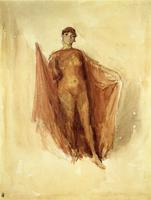
Dancing Girl
James McNeill Whistler
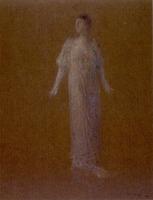
Untitled
Thomas Dewing

The Symbol of Spring
Edmund Charles Tarbell
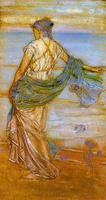
Annabel Lee
James McNeill Whistler
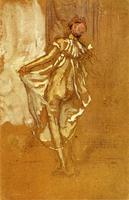
A Dancing Woman in a Pink Robe Seen from the Back
James McNeill Whistler
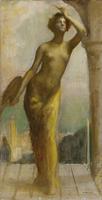
Painting. Sketch for the Salon des Arts at the Hôtel de Ville in Paris
Pascal Dagnan-Bouveret
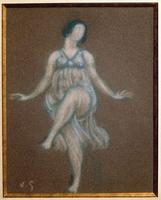
Portrait De Isadora Duncan
Valentine Hugo

Orientale au tambourin
Charles Hermans

June
Thomas Dewing
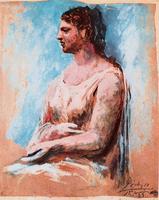
Seated woman
Pablo Picasso
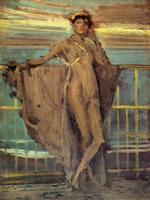
Sketch for Annabel Lee
James McNeill Whistler
Seated woman
Pablo Picasso
Three Female Figures Dancing And Playing
Edward Burne-Jones
Purple and Gold Phryne the Superb - Builder of Temples
James McNeill Whistler
The Servant
Odilon Redon