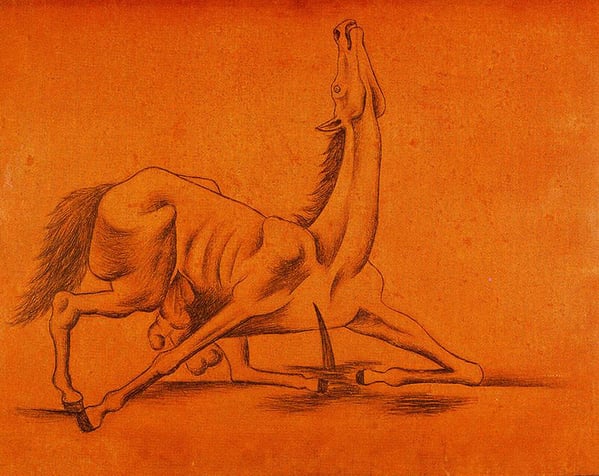
Expert analysis of Pablo Picasso’s Gutted horse
Style: Expressionism · Genre: animal painting
Expert Art Historical Analysis: "Gutted Horse" by Pablo Picasso
The supplied facts categorize this work under Expressionism, Cubist Period, and animal painting—a seemingly contradictory triad that reveals the work's true significance. It occupies a rare intersection where Picasso’s cerebral, geometric fracturing of form (the hallmark of his Cubist period, c. 1907–1914) collides with the raw, emotionally charged distortion of Expressionism. In Gutted Horse, Picasso does not merely depict an animal; he dissects it both literally and formally.
Significance within its Style and Period:
-
Hybridization of Cubist Structure with Expressionist Pathos
Cubism, at its core, is analytical and intellectual—breaking down objects into facets to represent multiple viewpoints simultaneously. Expressionism, by contrast, prioritizes subjective emotion over objective reality. Here, Picasso uses Cubist fragmentation (angular planes, overlapping perspectives) not as an academic exercise, but as a vehicle for visceral impact. The “gutted” quality—the exposed interior, the raw flesh—is rendered with sharp, slashing lines and jarring color shifts that don’t just describe anatomy but convey agony. This work stands as a rare moment where Picasso silences the cool distance of Cubism with the scream of Expressionism. -
Subversion of the Animal Painting Genre
Traditionally, animal painting (e.g., Stubbs’s horses, Delacroix’s lions) celebrates nobility, grace, or exoticism. Picasso inverts this: the horse is not a symbol of power or beauty but of vulnerability and violent deconstruction. The word “gutted” suggests butchery, evoking themes of sacrifice, war, or mortality. In this, the painting anticipates Picasso’s own later masterwork Guernica (1937), where the dismembered horse becomes a universal symbol of suffering. Gutted Horse thus prefigures the artist’s lifelong engagement with the wounded animal as a metaphor for human tragedy. -
Chronological and Stylistic Bridge
Executed during Picasso’s Cubist period, the work proves that Cubist language was never purely formal for him. It could be weaponized for expression. This painting challenges the common misperception of Cubism as cold or decorative, revealing instead a raw, barely controlled emotional force. It sits at the fulcrum between his earlier Blue/Rose Period pathos and his later Surrealist/Expressionist brutality, making it a crucial transitional piece.
In summary, Gutted Horse is significant because it dares to fuse the intellectual rigor of Cubism with the emotional urgency of Expressionism, reinventing the animal painting genre as a site of existential horror. It is a primal, groundbreaking work that expands the boundaries of both styles.
Museum / Gallery
Visually similar
20 works with related composition and palette
Love
Pedro Pont Vergés
Renvers
Jo Baer
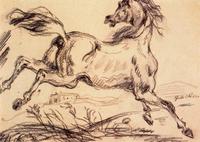
A horse
Giorgio de Chirico
Horse Smiling
Lucian Freud
Bt 2
Lech Jankowski
Knight, White Horse and Snake
Victor Brauner
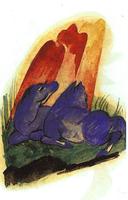
Two Blue Horses in Front of a Red Rock
Franz Marc
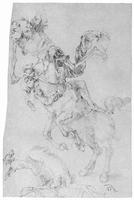
Death and rider
Albrecht Durer
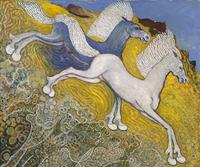
Kiddi og jeg
Johannes Sveinsson Kjarval
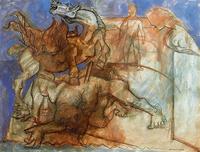
Minotaur is wounded, horse and personages
Pablo Picasso
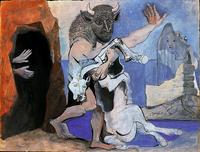
Minotaur with dead horse in front of a cave facing a girl in veil
Pablo Picasso
Never To Be Restrained
Mustafa al-Hallaj
La Nobiltà Dei Cavalli
Bruno Cassinari
Galloping Rider and other figures
Leonardo da Vinci
Studies of Leda and a horse
Leonardo da Vinci
Group of Seven Wild Horses
Hans Baldung
Study of a rider
Leonardo da Vinci
Bellerophon
Jerome Mesnager
The Unicorn (unfinished)
Salvador Dali
Faun, horse and bird
Pablo Picasso