
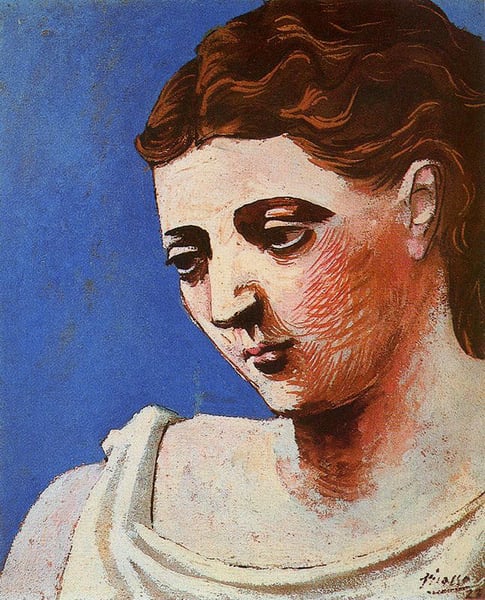
Expert analysis of Pablo Picasso’s Head of a woman
Style: Neoclassicism · Genre: portrait
Expert Analysis: "Head of a woman" by Pablo Picasso
Pablo Picasso’s Head of a Woman is a compelling fusion of two seemingly contradictory movements—Neoclassicism and Surrealism—that captures a pivotal moment in the artist’s evolution. Executed during his Neoclassicist & Surrealist Period (roughly 1917–1925), this portrait transcends mere likeness to become a meditation on form, emotion, and the classical ideal filtered through a modern, psychologically charged lens.
Neoclassical foundations
In the wake of World War I, Picasso deliberately turned away from the fragmentation of Cubism, embracing a simplified, monumental style inspired by Greco-Roman sculpture and the work of Ingres. Here, the woman’s profile is rendered with clean, continuous contours, a serene symmetry, and a sculptural weight that recalls ancient marble busts. The smooth modeling of the face, the calm, downward gaze, and the understated drapery-like treatment of the hair all testify to Picasso’s mastery of classical restraint. This return to order and timeless beauty was a deliberate counterpoint to the chaos of war, and it anchors the work in a tradition of idealized portraiture.
Surrealist subversion
Yet Picasso was never content with mere revival. The portrait’s significance deepens when viewed through his concurrent engagement with Surrealism. The features are subtly distorted: the eye—though classically almond-shaped—is slightly oversized and dislocated, floating on a planar surface that flattens depth. The nose and mouth are simplified to almost geometric forms, and the left side of the face recedes ambiguously, creating a hallucinatory shift between volume and silhouette. These distortions hint at inner psychological states—dream, memory, or desire—rather than objective reality. The head becomes a vessel for the unconscious, a surrealist readymade, as it were, carved from classical stone.
Dual significance
What makes Head of a Woman remarkable is its synthesis of polarities: order and disturbance, antiquity and modernity, public monument and private reverie. It stands as a testament to Picasso’s ability to work within a traditional genre—portraiture—while simultaneously deconstructing its conventions. The painting occupies a unique space in his oeuvre, bridging the calm, pregnant stillness of his neoclassical nudes (e.g., Two Women Running on the Beach) and the womb-like, biomorphic distortions of his later surrealist works (e.g., Woman with a Flower). Here, Picasso proves that Neoclassicism need not be backward-looking; it can be a vehicle for the most daring formal and psychological experimentation.
Conclusion
In Head of a Woman, Picasso achieves a rare equilibrium: the portrait feels eternal yet fugitive, serene yet unsettling. Its significance lies in this precarious balance—a moment when the classical ideal is not rejected but reimagined under the pressure of modern anxiety. It is a key work of the Neoclassicist & Surrealist Period, demonstrating that the most enduring art often emerges from the collision of opposites.
Museum / Gallery
Visually similar
20 works with related composition and palette
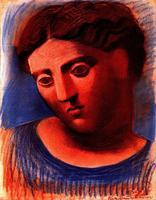
Head of woman
Pablo Picasso
Head of woman
Pablo Picasso

Head of woman
Pablo Picasso
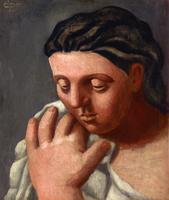
Woman's head and hand
Pablo Picasso
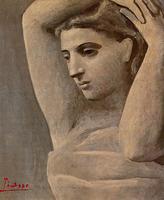
Bust of a woman, arms raised
Pablo Picasso
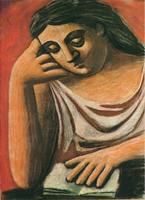
Reading
Pablo Picasso

Portrait of Akabi
Arshile Gorky
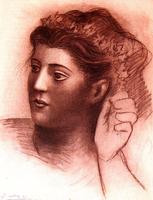
Head of woman
Pablo Picasso
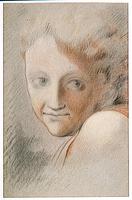
Head of an Angel
Correggio
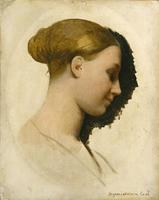
Madame Edmond Cave Marie Elisabeth Blavot
Jean Auguste Dominique Ingres
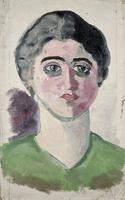
Portrait of Lena Milius
Theo van Doesburg
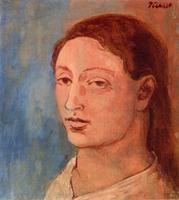
Fernande's Head
Pablo Picasso
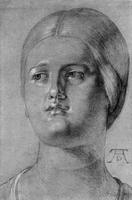
Head of a Woman
Albrecht Durer
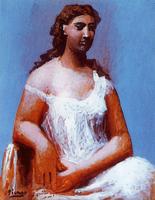
Seated woman
Pablo Picasso
Figura di Donna
Mario Tozzi
Madame Clément Boulanger, née Marie-Élizabeth Blavot, later Madame Edmond Cavé
Jean Auguste Dominique Ingres
Head Study of Maria Zambaco (The Wine of Circe)
Edward Burne-Jones
Study of a woman's head
Leonardo da Vinci
Three women at a fountain (study)
Pablo Picasso
Portrait of Venus
Julie Buchet