
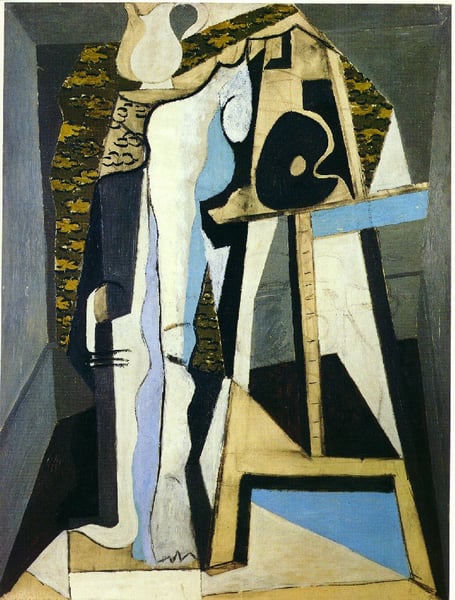
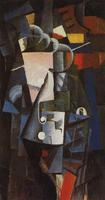
Interior with easel
Dettagli
Analisi esperta di Interior with easel di Pablo Picasso
Stile: Cubism · Genere: interior
Expert Analysis: "Interior with easel" (Pablo Picasso)
Pablo Picasso’s Interior with easel stands as a compelling synthesis of two seemingly divergent phases of his career: the structural rigor of Cubism and the psychological depth of his Neoclassicist & Surrealist Period. The work’s significance lies in how it reimagines the traditional interior genre through a Cubist lens while simultaneously anticipating the dreamlike, biomorphic forms that would define his later Surrealist explorations.
The composition treats the interior space not as a naturalistic room but as a fractured, multi-perspective plane. The easel—a symbol of the artist’s craft—becomes a geometric anchor, its legs and stretcher intersecting with furniture, walls, and ambiguous shadows. Picasso employs Cubist techniques such as faceted planes and tilted tabletop viewpoints, blurring the boundaries between object and void. Yet the palette and certain curvilinear passages (drapery, the easel’s crossbar) hint at the sensual, synthetic order of his Neoclassicist period, while the juxtaposition of flat and modeled forms creates a surreal tension—the room feels both concrete and hallucinatory.
What makes this work particularly significant is its role as a transitional bridge. Executed during the Neoclassicist & Surrealist Period (roughly 1917–1930), it demonstrates Picasso’s refusal to abandon Cubism’s analytical vocabulary even as he incorporated the classical monumentality and psychological ambiguity characteristic of his work in the 1920s. The interior becomes not merely a setting but a metaphysical space where the act of painting (the easel) and the painted environment collapse into one another, prefiguring Surrealism’s obsession with the subconscious drama of everyday objects.
In essence, Interior with easel is a masterclass in stylistic fusion—a picture that honors Cubism’s revolutionary dismantling of perspective while opening the door to the enigmatic interiors of Picasso’s later Surrealist visions. It is a quiet but pivotal work in his lifelong exploration of how space, form, and meaning can be remade on canvas.
Visivamente simili
20 opere con composizione e palette affini
Donna + ambiente
Enrico Prampolini
Figures and Marine Anchor
Louis Marcoussis
Blue and Black Abstract Composition
Tamara de Lempicka
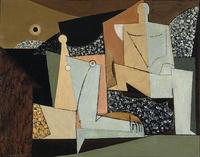
Figures on a Beach
Louis Marcoussis
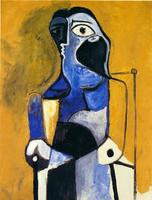
Seated woman
Pablo Picasso
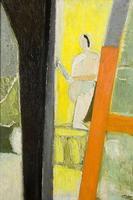
Nude Under a Bridge
Stanley Pinker
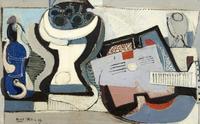
Zátiší Na Stole
Emil Filla
Les Dieux marins
Alfred Manessier
Painter and his model
Pablo Picasso
Painter and his model
Pablo Picasso
Composición Cubista Con Botella
Maria Blanchard
Bodegón
Maria Blanchard
Cubist Composition. Sitting Woman
Vytautas Kairiukstis
Untitled
Pablo Picasso
Window opened to the street Penthieure
Pablo Picasso
Young Woman
Pablo Picasso
Composition (Seated Nude)
Arthur Beecher Carles
Harlequin at Table
Juan Gris
Untitled (Cubist Figure)
Arshile Gorky
Vanity Box
Kazimir Malevich