
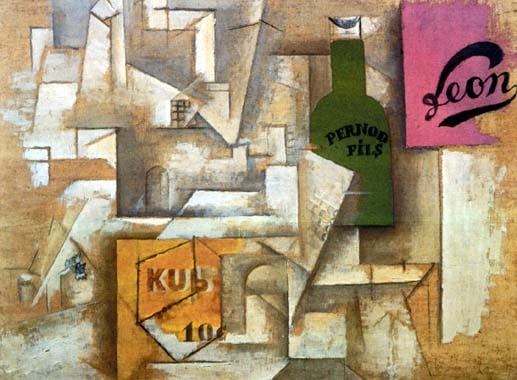
Expert analysis of Pablo Picasso’s Landscape with Posters
Style: Analytical Cubism · Genre: still life
Expert Art Historical Analysis: "Landscape with Posters" by Pablo Picasso
Overview of the Work
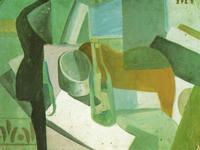
"Landscape with Posters" belongs to Picasso’s Analytical Cubist phase (circa 1909–1912), a period defined by the systematic deconstruction of form, the compression of spatial depth, and the use of a muted, earthy palette. Although its title suggests a natural scene, the work is classified as a still life—a common genre within Cubism—because its primary subject is a tabletop arrangement of objects, likely including fragmented posters or signage. This conflation of landscape and still life is itself significant: Cubism often merged interior and exterior spaces, flattening the distinction between background and foreground.
Significance within Analytical Cubism
Analytical Cubism sought to represent an object from multiple viewpoints simultaneously, breaking it into geometric facets and reassembling it on a shallow, ambiguous picture plane. In "Landscape with Posters," Picasso applies this method to a subject that bridges the everyday (posters as printed ephemera) and the painterly (the landscape). The posters act as semiotic markers—flattened, legible surfaces that contrast with the faceted, almost sculptural treatment of the surrounding space. This duality highlights Cubism’s central tension: the conflict between illusionistic depth and the flatness of the canvas.
Innovation: Posters as Proto-Collage
The inclusion of posters is particularly crucial. Just before Picasso and Braque introduced actual paper collage (e.g., Still Life with Chair Caning, 1912), they painted “fake” printed text or advertising signs. "Landscape with Posters" anticipates this breakthrough by treating the posters as iconic signs embedded within an abstract pictorial matrix. The word fragments and graphic shapes turn the painting into a meditation on representation itself—how signs (posters, letters) and painted marks both refer to reality yet remain irreducible to it. This self-reflexivity marks a turning point in modern art, moving from depiction to conceptual play.
Rethinking Genre and Tradition
By labeling a work with “landscape” in its title as a still life, Picasso challenges academic genre hierarchies. The “landscape” is not a vista but a collapsed space where a table, chair, or wall bears posters; the visual field becomes a collection of objects to be analyzed rather than a window onto nature. This subversion aligns with Cubism’s broader goal: to dismantle Renaissance perspective and replace it with a relational, cognitive mode of seeing.
Conclusion
"Landscape with Posters" is significant not only as a sterling example of Analytical Cubism’s fragmentary, multifocal vision but also as a precursor to collage and mixed-media art. Its fusion of the “low” (commercial posters) with “high” (still life painting) and its blurred genre boundaries encapsulate Cubism’s revolutionary impact on 20th-century visual language. The work stands as a document of Picasso’s relentless investigation into how painting can represent both the external world and the act of perception itself.
Visually similar
20 works with related composition and palette
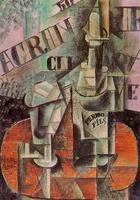
Table in a Cafe (Bottle of Pernod)
Pablo Picasso
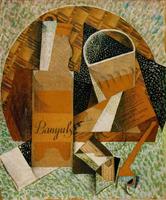
The Bottle of Banyuls
Juan Gris
Still life with bottle of rum
Pablo Picasso
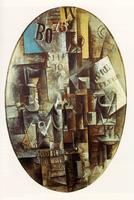
Violin, glass, pipe and inkwell
Pablo Picasso
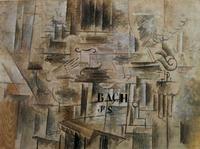
Homage to J.S. Bach
Georges Braque
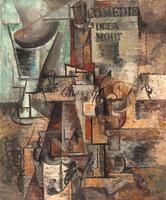
Zátiší S Lahví Cherry
Emil Filla
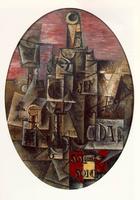
Spanish Still life
Pablo Picasso
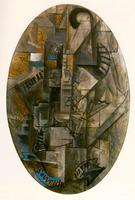
Souvenir from Havre
Pablo Picasso
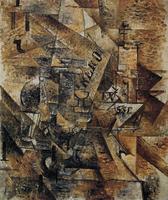
Still Life with a Pair of Banderillas
Georges Braque
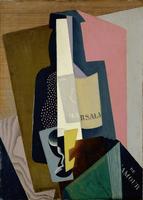
Still Life with Marsala Bottle
Gino Severini
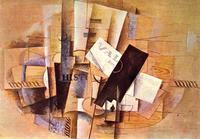
The musician's table
Georges Braque
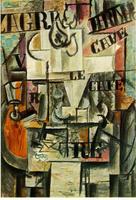
Fruit dish
Pablo Picasso
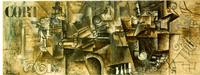
Still life on the piano ('CORT')
Pablo Picasso
Modok Mária, Szentendrei Tetők 1940
Modok Mária
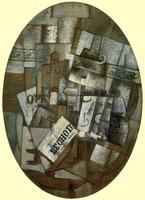
Pedestal Table
Georges Braque
Modok Mária. Szentendrei Háztetők 1940
Modok Mária
Still Life
Lyubov Popova
La composizione TA
Carlo Carra
Still Life before an Open Window (Place Ravignan)
Juan Gris
Still Life
Salvador Dali