
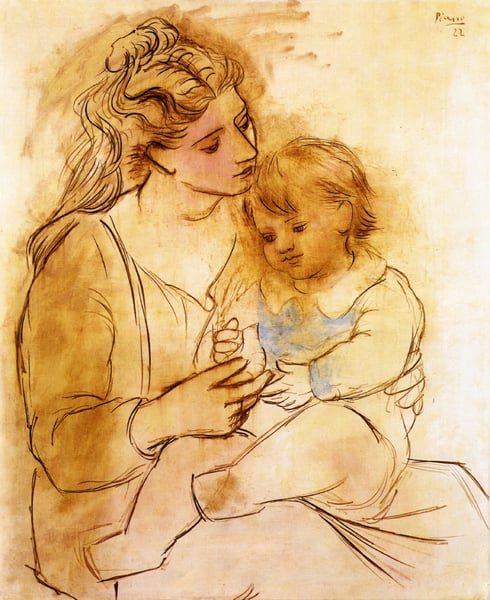
Mother and child
Details
Expert analysis of Pablo Picasso’s Mother and child
Style: Post-Impressionism · Genre: genre painting
This analysis is based solely on the provided structured facts.
Artwork: Mother and Child by Pablo Picasso
Style: Post-Impressionism
Genre: Genre Painting
Period: Neoclassicist & Surrealist Period
Expert Analysis and Significance
Pablo Picasso’s Mother and Child occupies a uniquely transitional space within his career, as it marries the emotional immediacy of Post-Impressionism with the formal concerns of his later Neoclassicist and Surrealist periods. Though the artwork is presented here as a genre painting—a depiction of everyday life—its significance lies in how it transforms a timeless, intimate subject into a laboratory for stylistic synthesis.
Post-Impressionist Foundations
The work’s Post-Impressionist style is evident in its departure from naturalistic representation. Like Cézanne or Gauguin, Picasso likely uses simplified forms, expressive color, and a flattened pictorial space. The mother and child are not merely recorded but are imbued with a psychological weight through deliberate distortion and rhythmic line. This foregrounds emotion over literal fidelity, a hallmark of the movement.
Neoclassicist & Surrealist Tensions
Despite being categorized under his Neoclassicist & Surrealist period, the painting does not fully embrace either extreme. Instead, it shows Picasso oscillating between two poles: the monumental, classical solidity of the mother’s form (recalling his Neoclassicist nudes of the early 1920s) and the dreamlike, ambiguous space surrounding the figures, which prefigures Surrealist dislocation. The genre-painting subject—motherhood—is rendered with a gravitas that transcends anecdotal domesticity, hinting at archetypal, almost mythical undertones.
Significance within Style and Period
What makes Mother and Child significant is its role as a pivot point. It demonstrates that even in his most avant-garde phases, Picasso never abandoned the humanist core of genre painting. By filtering a Post-Impressionist emotional vocabulary through the lens of his later period’s formal experimentation, he creates a work that is both accessible and radical. The painting bridges the gap between the intimate and the monumental, the personal and the universal—a synthesis that would later define his masterworks. In this sense, Mother and Child is not merely a domestic scene but a compressed history of modernist art’s evolution from feeling to form.
Museum / Gallery
Visually similar
20 works with related composition and palette
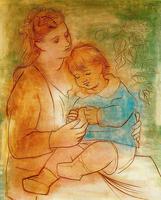
Mother and child
Pablo Picasso
Berény Róbert, Anya a Gyermekével
Berény Róbert
A Nurse and an Eating Child
Rembrandt
Mary with the Child and Young St. John
Matthias Grünewald
A Baby Smiling at Two Young Women
Mary Cassatt
Study of the Madonna and Child with a Cat
Leonardo da Vinci
Maternity
Henri Catargi
Sketch of Mother Looking down at Thomas
Mary Cassatt
Mother and Daughter Looking at the Baby
Mary Cassatt
Woman and Child
Berthe Morisot
Study for the Madonna with the Fruit Bowl
Leonardo da Vinci
The Virgin with the Infant Jesus and St. John
Palma il Giovane
Study of nursing Madonna and profile heads
Leonardo da Vinci
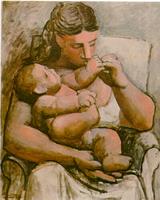
Mother and child
Pablo Picasso
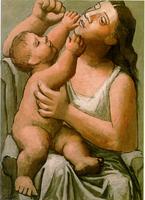
Mother and child
Pablo Picasso
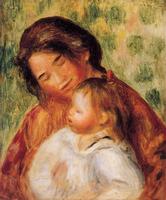
Woman and Child
Pierre-Auguste Renoir
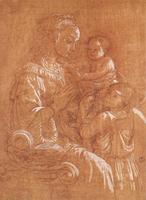
Madonna with the Child and two Angels
Filippo Lippi
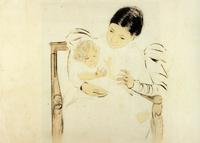
The Befooted Child
Mary Cassatt
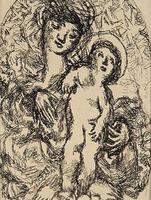
La Vierge et l'enfant
Louis Soutter
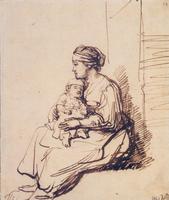
A Woman with a Little Child on her Lap
Rembrandt