
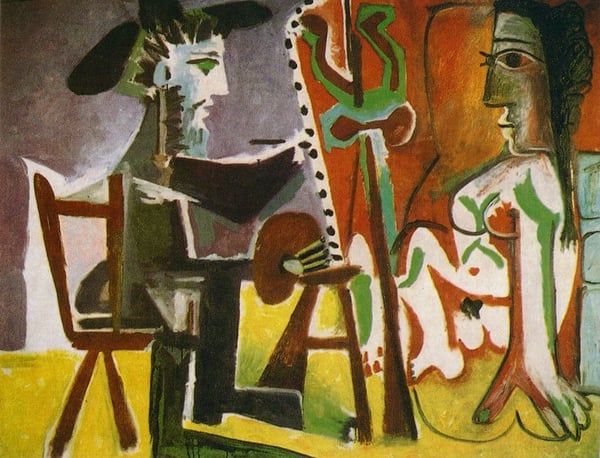
Analisi esperta di Painter and his model di Pablo Picasso
Stile: Cubism, Naïve Art (Primitivism) · Genere: genre painting
Expert Art Historical Analysis: Painter and His Model by Pablo Picasso
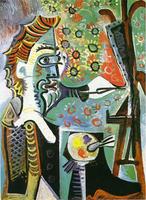
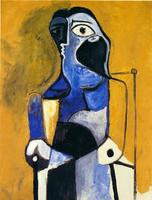
Pablo Picasso’s Painter and His Model stands as a significant late-career synthesis of two seemingly divergent styles—Cubism and Naïve Art (Primitivism)—within the traditional genre of genre painting. Executed during Picasso’s Later Years, this work exemplifies his enduring fascination with the artist’s studio as a subject, while simultaneously collapsing the boundaries between high modernist abstraction and the direct, unpolished aesthetics of folk and tribal art.
Stylistic Significance (Cubism & Primitivism) The painting retains the hallmark visual language of Cubism: fractured planes, multiple perspectives compressed into a single surface, and a muted, earthy palette that recedes into geometric scaffolding. Yet Picasso overlays this with a Naïve, Primitivist impulse—simplified forms, bold outlines, and a deliberate flattening of space that evokes the directness of children’s drawings or African masks. This fusion is not merely decorative; it represents a mature artist’s return to the “primitive” origins of visual expression, stripping away illusionism to expose the bare act of making a picture.
Treatment of the Genre (Genre Painting) As a genre painting, Painter and His Model depicts a classic studio scene: the artist (likely a self-referential stand-in for Picasso) confronts his model. However, the Cubist distortion and Primitivist stylization transform this conventional motif into a meditation on representation itself. The model is not a passive object but a constellation of overlapping angles and mask-like features, while the painter becomes a composite of hands and gaze. The equal weight given to both figures suggests a dialogue—and a tension—between creator and created, echoing Picasso’s lifelong interrogation of the relationship between reality and art.
Context of the Later Years In his later period, Picasso often revisited earlier themes with a new, often playful freedom. Here, the Primitivist influence recalls his groundbreaking Les Demoiselles d’Avignon (1907), but tempered by decades of Cubist experimentation. The result is a work that feels both retrospective and freshly inventive: a meditation on the very process of artistic creation, rendered through the dual lenses of intellectual abstraction and instinctual mark-making.
Why This Work Matters Painter and His Model is significant because it demonstrates Picasso’s ability to reconcile opposing artistic philosophies within a single canvas. It shows Cubism not as a dry, analytical system but as a flexible language that can absorb the raw energy of Primitivism. Furthermore, by placing the artist-model relationship at its heart, it forces viewers to confront the artist’s role—not as a passive observer, but as a constructor of visual realities. The painting stands as a testament to Picasso’s unending reinvention, proving that even within the well-worn genre of studio scenes, he could forge a new, provocative vision.
Visivamente simili
20 opere con composizione e palette affini
Painter and his model
Pablo Picasso
Painter and his model
Pablo Picasso
Painter and his model
Pablo Picasso
Jeux des formes
Serge Brignoni
Man with mandolin
Pablo Picasso
The Liver is the Cock's Comb
Arshile Gorky
Lying female nude
Pablo Picasso
Berlini Kabaré
Bela Kadar
An artist
Pablo Picasso
Hombre Con Guitarra
Maria Blanchard
Water of the Flowery Mill
Arshile Gorky
Zátiší Na Stole
Emil Filla
The Chess Players
Marcel Duchamp
Untitled (Cubist Figure)
Arshile Gorky
Embrace
Pablo Picasso
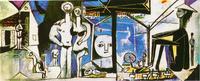
The beach in Garoupe
Pablo Picasso
Shamanistic painting - abstract painting by Fons Heijnsbroek - Dutch artist
Fons Heijnsbroek
Femme au Fauteuil
Albert Gleizes
Polynesian
Hans Hofmann
Seated woman
Pablo Picasso