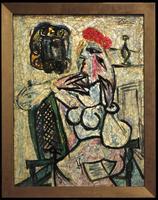
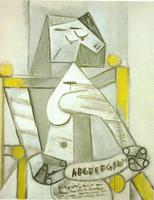
Pablo Picasso’s Seated Woman with Fish (1928–1932) is a pivotal work from his Neoclassicist & Surrealist Period, embodying his unique fusion of portraiture with Surrealist dream logic. While Surrealism often embraced automatic techniques and biomorphic forms, Picasso here applies a controlled distortion that transforms the seated figure into a hybrid creature—the fish motif hinting at subconscious metamorphosis and a playful subversion of traditional female portraiture. The painting’s significance lies in how it bridges Picasso’s earlier Neoclassicist interest in monumental human form with Surrealism’s desire to liberate the psyche, resulting in an image that feels simultaneously classical and irrationally strange. By grafting a fish onto the woman’s posture or identity, Picasso creates a visual paradox that unsettles the viewer’s expectations, marking his distinctive contribution to Surrealist painting: a deliberate, almost architectural disordering of reality that still retains a strong compositional structure.