
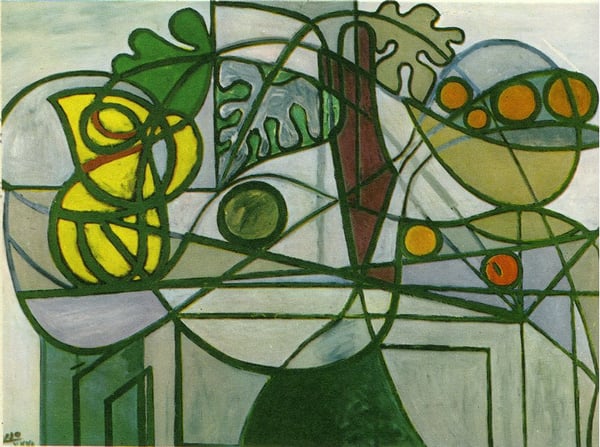
Still life
Details
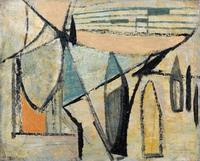
Expert analysis of Pablo Picasso’s Still life
Style: Surrealism · Genre: still life
Expert Art Historical Analysis: Pablo Picasso's "Still Life" (Neoclassicist & Surrealist Period)
Pablo Picasso’s Still Life from his Neoclassicist & Surrealist Period (roughly 1920s–1930s) stands as a pivotal intersection of two seemingly opposing impulses: the ordered, sculptural clarity of neoclassicism and the irrational, dreamlike liberation of Surrealism. While the subject matter is a traditional genre—still life—Picasso subverts its conventions by deploying Surrealist strategies of dislocation, metamorphosis, and ambiguous space.
Significance within Style and Period:
-
Surrealist Transformation of the Ordinary – The objects in this painting (table, fruit, vessel, etc.) are not rendered with realistic fidelity. Instead, they are distorted, fragmented, or merged into biomorphic forms that hint at organic or psychological states. This aligns with Surrealism’s goal of unlocking the unconscious by defamiliarizing the everyday.
-
Dialogue between Neoclassical Structure and Surrealist Disruption – Concurrent with his Surrealist experiments, Picasso retained a neoclassical interest in monumental, sculptural volumes and clear outlines. In this still life, the composition may retain a stable, architectonic arrangement (e.g., a central table, vertical/horizontal axes), but within that framework, individual elements warp, tilt, or morph in impossible ways—creating a tension between order and chaos that defines the artist’s hybrid period.
-
Reimagining Pictorial Space – Unlike traditional still lifes that rely on a fixed perspective, Picasso collapses foreground and background, tilts surfaces, and introduces shifting viewpoints. This ambiguity forces the viewer to question the stability of reality itself—a core Surrealist ambition.
-
Biomorphism and Metaphor – Many of Picasso’s still lifes from this era treat objects as metaphors for the body or psyche. A bottle might take on a phallic or female contour; a piece of fruit could resemble a head. This slipping between categories of object, animal, and human is a hallmark of Surrealist visual poetry.
Why This Work Matters:
Picasso’s Still Life is significant because it demonstrates how Surrealism could be practiced not only through overtly fantastic scenes but through the quiet, radical reimagining of a canonical genre. It bridges his neoclassical discipline—seen in the weight and solidity of forms—with Surrealist spontaneity and psychological depth. The painting thus encapsulates the artist’s unique ability to synthesize tradition with avant-garde experimentation, making it a key document of the 1920s–30s moment when Picasso oscillated between order and dream.
Visually similar
20 works with related composition and palette
Red Oval
Wassily Kandinsky
Finnegan's Lake
Gillian Ayres
Fruits
Tihamer Gyarmathy
La lanterne et le petit haricot
Le Corbusier
Mythe
Ernst Wilhelm Nay
The Garden of Eden
Stanley Pinker
Rencontre sur une plage
Wolfgang Paalen
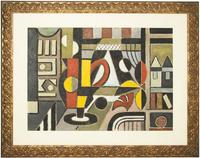
Untitled
Thomas Nonn
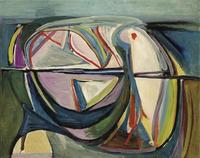
Untitled
Bram van Velde
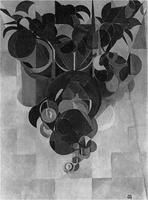
Composition IV (Still life)
Theo van Doesburg
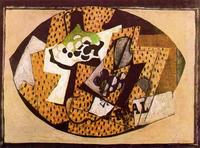
Still Life with Grapes (II)
Georges Braque
Untitled
Artin Demirci
Le bonheur de Matisse
Bram van Velde
Still Life on a Table
Georges Braque
Untitled
Pablo Picasso
Komposition mit rotem Bogen
Fritz Winter
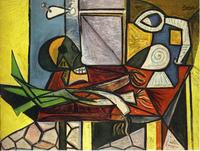
Skull and leeks
Pablo Picasso
Autumn
Tamara de Lempicka
Cin-Zin
Karl Knaths
Jockey
Huguette Arthur Bertrand