
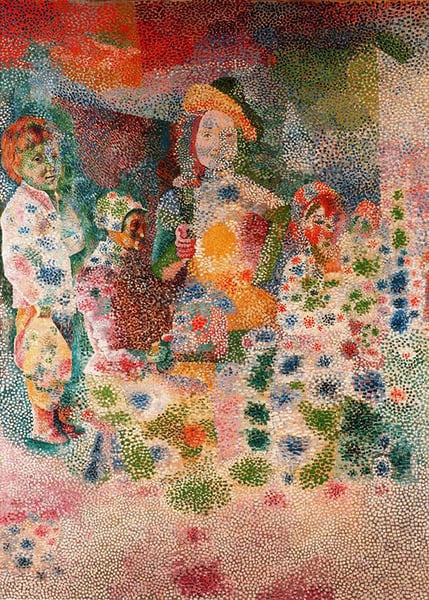
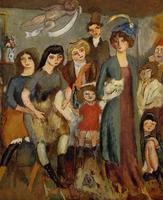
Pablo Picasso の The happy family の専門的な分析
スタイル:Pointillism · ジャンル:genre painting
Artwork Analysis: The Happy Family by Pablo Picasso
Structured Facts:
- Artist: Pablo Picasso
- Title: The Happy Family
- Style: Pointillism
- Genre: Genre painting (depiction of everyday life)
- Period: Cubist Period
Expert Description:
The Happy Family stands as a remarkable and rare synthesis of two seemingly divergent artistic languages: the meticulous, color-dappled technique of Pointillism and the radical, fragmented forms of Picasso’s Cubist Period. While Pointillism (pioneered by Seurat and Signac) relies on tiny dots of pure color to build form through optical mixing, Cubism—especially in its Analytic phase—deconstructs objects into geometric planes and multiple viewpoints. Picasso’s decision to merge these approaches in a single work is itself historically significant.
Within the context of Picasso’s Cubist output (c. 1907–1917), The Happy Family defies expectation. Instead of dissecting a still life or a portrait into angular shards of muted earth tones, it embraces the genre painting tradition—a domestic, cheerful scene of family life—and renders it through Pointillist stipples. This creates a tension between the static, scientific touch of Pointillism and the dynamic, intellectual structure of Cubism. The “happy” subject matter further complicates the cold objectivity often associated with both movements, injecting a warm, narrative intimacy.
Why It Matters:
- Hybrid Innovation: It demonstrates Picasso’s restless experimentation, proving that his influence was not limited to Cubism but extended to reinterpreting other styles. The work challenges the notion that artistic periods are mutually exclusive.
- Post-Impressionist Echo: By employing Pointillism during his Cubist phase, Picasso pays homage to Seurat while simultaneously pushing that technique into a modern, geometric realm—an early example of stylistic appropriation that would define much 20th-century art.
- Genre as Laboratory: The everyday family scene allowed Picasso to test how Pointillist color dots could create volumetric planes when arranged in Cubist compositions, foreshadowing later developments like Synthetic Cubism’s use of collage-like color fields.
Ultimately, The Happy Family is significant because it occupies a unique crossroads: a moment when Picasso was not merely breaking forms apart but also reassembling them with the rhythmic, luminous vocabulary of a rival movement. The result is a poignant, technically audacious work that expands our understanding of both Pointillism and Cubism.
Museum / Gallery
視覚的に類似
構図やパレットが近い作品 20 件
Daudet
Bela Czobel
Cheo
Bui Xuan Phai
A Story
George Stefanescu
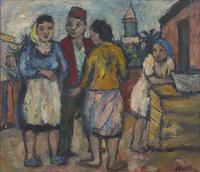
Malays, Chiappini Street, Cape Town, 1976
Kenneth Baker
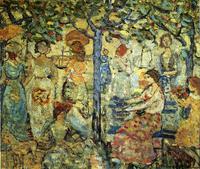
Acadia
Maurice Prendergast
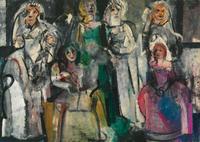
Grand Street Brides
Grace Hartigan
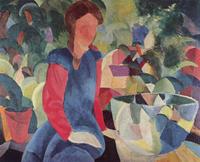
Girl with a Fish Bowl
August Macke
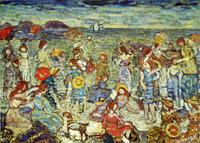
The Cove
Maurice Prendergast
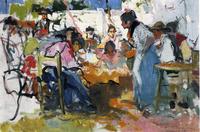
Net Menders in Valencia
Joaquín Sorolla
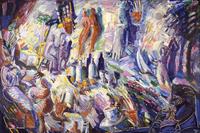
Homage to Still Life
Carlos Almaraz
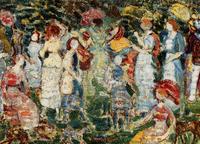
Picnic Grove
Maurice Prendergast
Market Scene
Maurice Prendergast
Girl in the greenery
August Macke
Girls in the Park
Maurice Prendergast
Five children on the edge of the meadow
Paula Modersohn-Becker
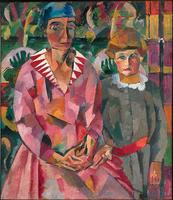
Portrait of Artist's Wife and Daughter
Aristarkh Lentulov
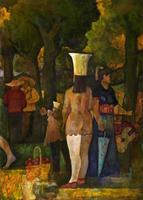
The White Stocking
William Balthazar Rose
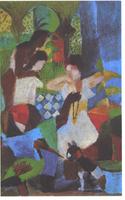
Turkish jewelry dealer
August Macke
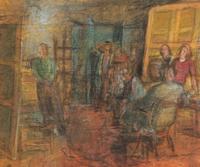
Berény Róbert, Látogatás a Műteremben
Berény Róbert
The Turkish Family
Jules Pascin