Analisi esperta di Five children on the edge of the meadow di Paula Modersohn-Becker
Stile: Expressionism · Genere: sketch and study
Expert Analysis: "Five children on the edge of the meadow" by Paula Modersohn-Becker
Style & Genre Significance
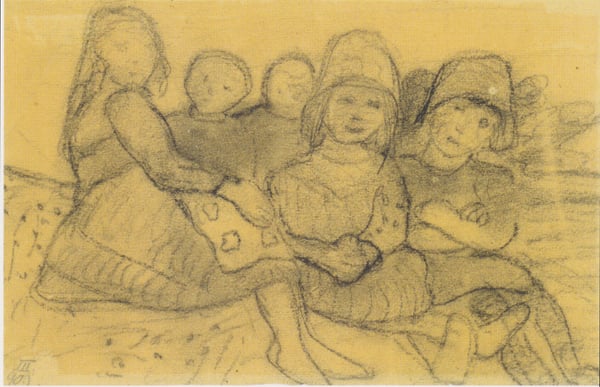
As an Expressionist sketch and study, this work exemplifies Modersohn-Becker’s pioneering break from naturalistic representation. Expressionism at its core prioritizes emotional intensity over literal depiction, and here the unfinished, gestural quality of a study amplifies that rawness. The “edge of the meadow” setting is not merely a landscape but a liminal space—between nature and human presence, between childhood and the adult world.
What Makes It Significant
- Radical Simplicity – As a sketch, the work strips away detail to capture the essence of childhood: the awkward, unposed grouping of five children. Their placement at the meadow’s edge suggests a transitional moment, typical of Modersohn-Becker’s interest in quiet, ordinary life.
- Expressionist Innovation – Even in a preliminary study, the artist’s hand conveys emotion through abbreviated lines and soft focus. The children are not idealized but feel immediate, vulnerable—a hallmark of early Expressionism’s shift toward subjective human experience.
- Artistic Process Revealed – The work’s value lies in its rawness: it documents Modersohn-Becker’s working method, showing how she captured fleeting observations before translating them into more finished pieces. This transparency offers a rare glimpse into the creative spark of a major Expressionist.
Conclusion
This sketch matters because it condenses Modersohn-Becker’s revolutionary vision into its most elemental form: a moment of childhood on the cusp of modernity, rendered with an expressiveness that transcends its preliminary status. It is a key example of how Expressionist artists elevated even their studies into profoundly human statements.
Visivamente simili
20 opere con composizione e palette affini
Untitled
Dilek Demirci
Untitled
Dilek Demirci
Peasants
Martiros Sarian
Schonberg Family
Richard Gerstl
Czóóbel Béla Fiatal Pár
Bela Czobel
Untitled
Dilek Demirci
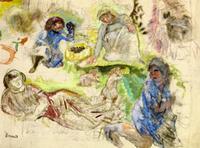
Figure Studies for Le Printemps
Pierre Bonnard
Béla Czóbel, In the Room
Bela Czobel
Child in Black
Egon Schiele
Malays, Chiappini Street, Cape Town, 1976
Kenneth Baker
A Story
George Stefanescu
Modok Mária, Fekete Blúzos Nő
Modok Mária
Zigeunerfamilie
Otto Mueller
Seated Peasant Woman Crunching an Apple
Camille Pissarro
Modok Mária, Szobában 1961
Modok Mária
Támaszkodó Lány
Bela Czobel
Menina triste e doente
Jose Pancetti
Women Outside
Richard Diebenkorn
Bela Czobel, Young Girl
Bela Czobel
Virágcsendélet
Bela Czobel