
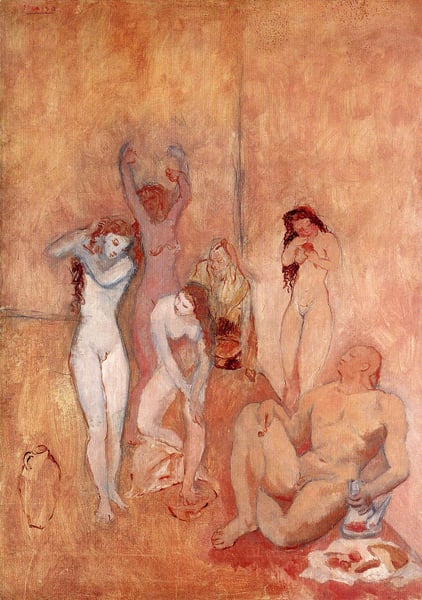
Экспертный разбор работы «The Harem» художника Pablo Picasso
Стиль: Expressionism · Жанр: genre painting
Expert Analysis of "The Harem" by Pablo Picasso
Style & Period Significance
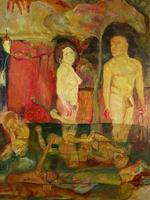
Painted during Picasso’s Rose Period (1904–1906), The Harem marks a transitional moment when the artist’s signature melancholy and blue-toned figures gave way to warmer pinks, ochers, and earthy reds. While the work is categorized here as Expressionism, it predates the formal emergence of that movement—yet it already displays the emotional distortion of form and color that Expressionists would later champion. Picasso uses the harem theme not as an orientalist fantasy but as a vehicle for psychological tension, deconstructing the languid odalisque tradition of Ingres or Delacroix.
Genre Painting Reimagined
As a genre painting, The Harem depicts everyday life—or rather, a constructed, intimate interior. However, Picasso subverts the expected narrative. The figures are crowded, almost claustrophobic, with flattened space and awkward postures that deny sensuality. This aligns with Expressionism’s goal: to convey inner states rather than outward reality. The painting’s significance lies in its break from naturalism: the women’s faces are mask-like, anticipating the African-mask-inspired simplification of Picasso’s later Les Demoiselles d’Avignon (1907).
Critical Distinction
What makes The Harem notable within Picasso’s Rose Period is its bold shift toward expressive distortion even as it retains the period’s soft palette. The composition is intentionally unresolved—bodies overlap without clear spatial logic, limbs seem disconnected—forcing the viewer to read the scene as a raw emotional tableau rather than a literal harem. This work thus stands as a crucial stepping stone from Picasso’s early lyrical style to the revolutionary formal experiments of Cubism, while already embodying the core Expressionist impulse to prioritize subjective feeling over objective depiction.
Визуально похожие
20 работ с близкой композицией и палитрой
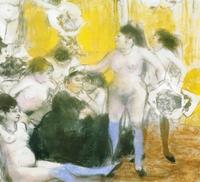
The festival of the owner
Edgar Degas
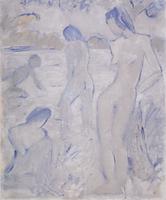
Badende
Otto Mueller
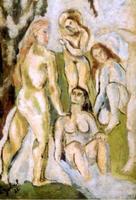
Czobe Bela 1932 Les Baigneuses
Bela Czobel
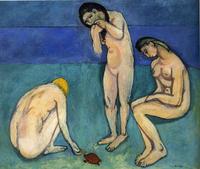
Bathers with a Turtle
Henri Matisse
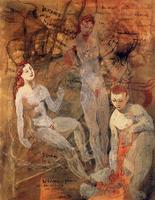
Three nudes
Pablo Picasso
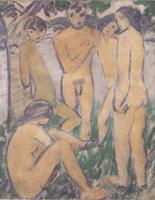
Fünf Akte Am Wasser
Otto Mueller
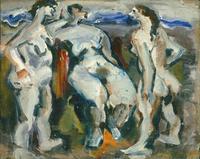
Untitled (Three Nudes)
Mark Rothko
Nudes in landscape
Roger de La Fresnaye
Naked women in a landscape
Arturo Souto
Zwei Am Teichrand Sitzende Mädchenakte
Otto Mueller
Badende in Braun
Otto Mueller
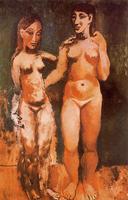
Two nude women
Pablo Picasso
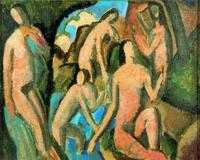
Bathing women
Andre Derain
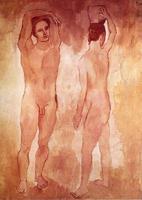
Teenagers
Pablo Picasso
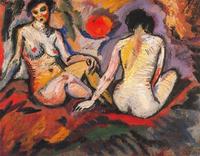
Two seated nudes
Albert Bloch
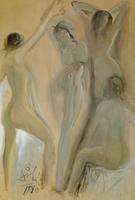
Les Dlemoilselles D'Avignon (The Girls of Avignon)
Salvador Dali
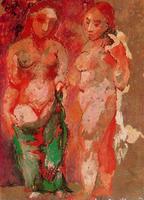
Nude woman naked face and nude woman profile
Pablo Picasso
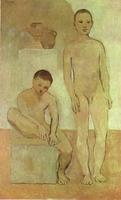
Teenagers
Pablo Picasso
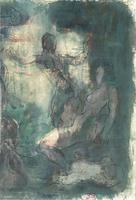
Nude Figures in a Room
Alexandre Jacovleff
The Fall
Paul F. Yount