
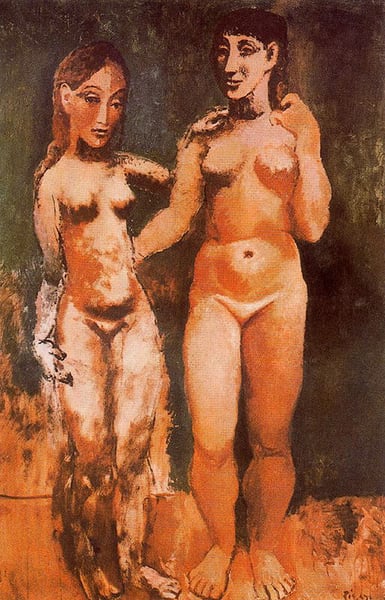
Analisi esperta di Two nude women di Pablo Picasso
Stile: Expressionism · Genere: nude painting (nu)
Expert Analysis of "Two Nude Women" by Pablo Picasso
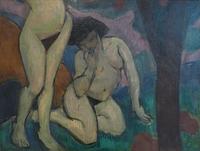
This work, executed during Picasso’s Rose Period (c. 1904–1906), marks a pivotal shift from the somber, blue-tinted despair of his earlier years to a warmer, more optimistic palette—here dominated by pinks, ochres, and muted earth tones. Though the supplied facts classify it as Expressionism, it is important to note that Picasso’s Rose Period predates the formal emergence of German Expressionism; nevertheless, the painting embodies an expressive intensity that anticipates the movement’s emotional subjectivity and distortion of form for psychological impact.
Significance within the Rose Period and Expressionist Lens
- Transitional emotional register: The two nude women are depicted with a gentle, almost melancholic sensuality, their elongated limbs and simplified facial features conveying vulnerability and intimacy. This contrasts with the harrowing poverty of the Blue Period, introducing themes of companionship and quiet sensuality that would later bloom in Picasso’s Primitivist and Cubist phases.
- Expressionist handling of line and color: Even within the Rose Period’s restrained palette, Picasso uses bold, rhythmic contours and flattening of space. The figures are not anatomically precise but are distorted to heighten emotional resonance—a hallmark of Expressionist thinking. The warm flesh tones and soft modelling create a sense of tender isolation, as if the women exist in a dreamlike, non-naturalistic realm.
- Genre innovation: As a nude painting, the work reimagines the traditional academic nude through a modern, psychological lens. Picasso abandons classical idealism in favor of raw, unsettled humanity—foreshadowing the radical deconstruction of the body that would define his later career.
Art-Historical Significance
- This painting bridges Picasso’s early Symbolist influences (especially the elongated figures of El Greco and the emotional palette of Toulouse-Lautrec) with the expressive distortion that would fully erupt in works like Les Demoiselles d’Avignon (1907).
- Within the context of Expressionism, it demonstrates that emotional truth can be achieved through subtle color shifts and gestural line, not only through exaggerated angst. The quiet, introspective mood of Two Nude Women offers a counterpoint to the more aggressive Expressionist works of Kirchner or Schiele, yet shares their commitment to subjective experience over objective representation.
In sum, this painting is significant as a crucial document of Picasso’s evolving style—a moment when the Rose Period’s lyricism meets the nascent emotional force of Expressionism, creating a deeply humanist vision of the nude that challenges both academic tradition and the emerging avant-garde.
Visivamente simili
20 opere con composizione e palette affini
Nude woman naked face and nude woman profile
Pablo Picasso
Two nude women
Pablo Picasso
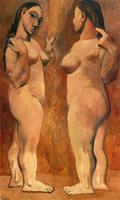
Two nude women
Pablo Picasso
Untitled (Three Nudes)
Mark Rothko
Nu Cubista N°1
Anita Malfatti
Zwei Mädchen
Otto Mueller
Standing Nude
Zinaida Serebriakova
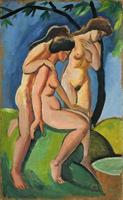
Three Nudes
August Macke
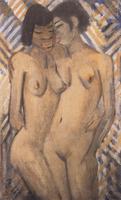
Zwei Negermädchen
Otto Mueller
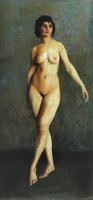
Figure in Motion
Robert Henri
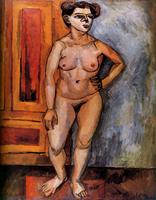
Nude
Raoul Dufy
The Three Graces
Edward Burne-Jones
Drawing of Female Nude with charcoal and chalk
Pierre-Paul Prud'hon
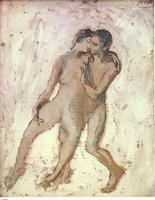
Nudes interlaces
Pablo Picasso
Nude
Ilya Mashkov
Three Nudes in the Forest
Otto Mueller
Zwei Mädchen
Otto Mueller
The Model
Henri Matisse
Teenagers
Pablo Picasso
Nudes in landscape
Roger de La Fresnaye