
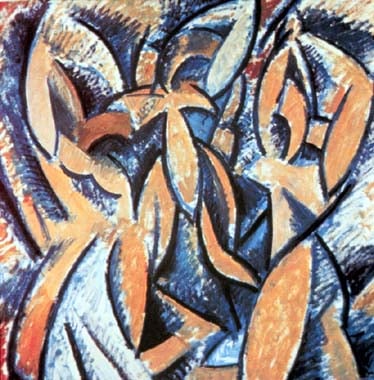
Three women (Rhythmical version)
Details
Expertenanalyse zu Pablo Picassos Three women (Rhythmical version)
Stil: Cubism · Genre: nude painting (nu)
Expert Analysis of Pablo Picasso’s "Three Women (Rhythmical Version)"
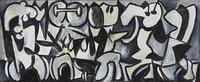
This work occupies a pivotal position in Picasso’s evolution toward full Cubism, situated squarely within his African Period (c. 1907–1909). As a nude painting executed in a Cubist idiom, it demonstrates the artist’s radical departure from classical representation toward a more structural, conceptual approach to the human figure.
Significance within the African Period
The African Period is defined by Picasso’s absorption of Iberian sculpture and African tribal masks, which he encountered in ethnographic museums and through colleagues like Matisse. In Three Women, this influence manifests in the angular, mask-like faces and the stark, geometric simplification of the female bodies. The figures are no longer rendered with naturalistic curves or shading; instead, they are built from abrupt, faceted planes that fracture the anatomy into a series of rhythmic, interlocking shapes. This treatment directly echoes the formal abstraction of African carving, where volumes are suggested through sharp edges and symmetrical distortions.
Cubist Innovation
While the painting predates the fully developed Analytical Cubism of 1910–1912, it already displays the key Cubist principle of multiple viewpoints and flattened pictorial space. Each woman is seen from several angles simultaneously—face, torso, and limbs are disassembled and reassembled in a single plane. The “rhythmical version” in the title emphasizes the repetition and flow of these fragmented forms: the figures repeat similar angular poses and align along a syncopated, almost musical arrangement of dark and light planes. This rhythmic structure creates a sense of movement and internal tension, pushing the composition beyond static representation into a dynamic, active space.
Genre Transformation
As a nude painting (genre: nu), the work subverts the traditional Western nude—normally idealized, soft, and erotic—by presenting the female body as a raw, almost brutal assemblage of geometric blocks. The flesh is not sensuous but architectonic; the figures become part of the overall grid-like composition, integrated with the background rather than standing out from it. This revolutionary handling marks a definitive break with academic tradition and anticipates the total abstraction of later Cubist works.
Conclusion
Three Women (Rhythmical Version) is significant as a landmark of transition—from Picasso’s early African-inspired primitivism to the mature Cubism that would transform modern art. Its rhythmic, faceted forms, mask-like visages, and rejection of illusionistic space encapsulate the core tensions of the African Period, making it an essential example of how tribal art catalyzed the development of Cubism’s formal language.
Visuell ähnlich
20 Werke mit ähnlicher Komposition und Farbpalette
Removal
Andre Masson
Nude with Raised Arms (The Avignon Dancer)
Pablo Picasso
Composition
Andre Lanskoy
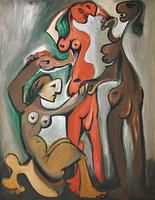
Tři Grácie
Emil Filla
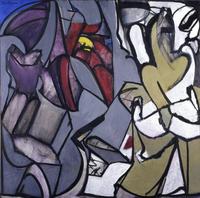
Frank O'Hara, 1926-1966
Grace Hartigan
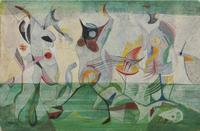
Mirage oceanique
Serge Brignoni
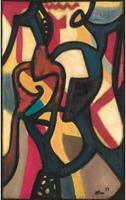
Agrigente
Jean-Michel Atlan
Dynamism of the Human Body
Umberto Boccioni
La Naissance Attendue (Expected Birth)
Andre Lanskoy
Untitled
Jean-Michel Atlan
Untitled
Jean-Michel Atlan
Dancers
Charles Alston
Composition I
Patrick Henry Bruce
Gul figur
Gosta Adrian-Nilsson
Le bal Musette
Georges Valmier
A girl from Avignon
Pablo Picasso
Dance IV
Frank Lobdell
AP 1910 Seated Nude 2019
Anthony Padgett
Dance I
Frank Lobdell
Zarabanda en blanco y negro
Oswaldo Vigas