
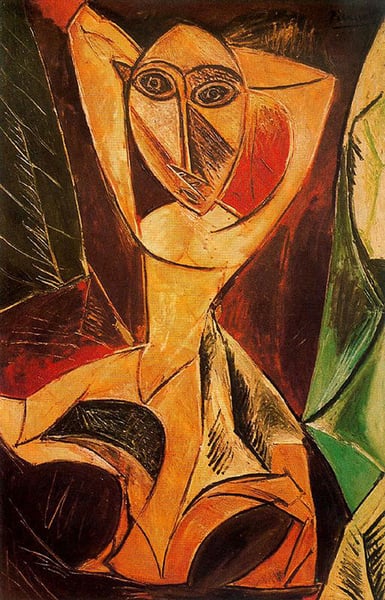
Nude with Raised Arms (The Avignon Dancer)
Dettagli
Analisi esperta di Nude with Raised Arms (The Avignon Dancer) di Pablo Picasso
Stile: Cubism · Genere: nude painting (nu)
Expert Analysis: "Nude with Raised Arms (The Avignon Dancer)" by Pablo Picasso
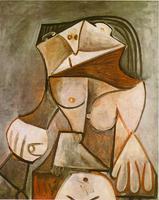
Pablo Picasso’s Nude with Raised Arms (The Avignon Dancer) is a pivotal work from the artist’s African Period (1907–1909), a moment of radical stylistic ferment that directly paved the way for the invention of Cubism. This painting sits at the intersection of two major breakthroughs: the raw, ritualistic power of African sculpture and the nascent fragmentation of form that would define early Cubist space.
Context and Stylistic Significance
The "African Period" was catalyzed by Picasso’s encounter with African masks and Iberian statuary, most famously synthesized in his 1907 masterpiece Les Demoiselles d’Avignon. This work—often considered a related study or variant—bears the same angular, mask-like face and jarring posture. The raised arms, a dynamic gesture that suggests dance or trance, echo the expressive distortions found in African ceremonial figures. Picasso deliberately rejects classical proportions: the figure’s torso is flattened into geometric planes, the breasts are simplified to near-abstract cones, and the background dissolves into fractured, faceted strokes.
Cubist Precursor and Formal Innovation
Though still tethered to a recognizable nude, the painting already exhibits the core Cubist tenets: a reduction of three-dimensional space to shallow, interlocking planes, and a disregard for naturalistic modeling. The raised arms create a rhythmic, almost calligraphic silhouette that breaks the continuous outline—an early sign of the "passage" technique (overlapping planes) that Picasso and Braque would soon perfect. The flesh tones are muddied with ochres and earth colors, reminiscent of both African wood carvings and the somber palette of the subsequent Analytic Cubism.
Placement in Art History
What makes this work significant is its role as a transitional bridge—it retains the explosive, primal energy of the African Period while forecasting the intellectual rigor of Cubism. The dancer’s raised arms are not merely decorative; they force the viewer’s eye to read the figure as a constellation of disparate angles, demanding a new kind of visual comprehension. In this sense, Nude with Raised Arms is a laboratory where Picasso tested the fragmentary vision that would soon dismantle conventional representation altogether. It stands as a crucial document of how non-Western art helped liberate Western painting from illusionism, steering it toward the multi-perspectival logic of modernity.
Museum / Gallery
Visivamente simili
20 opere con composizione e palette affini
A girl from Avignon
Pablo Picasso
Dance of the Veils
Pablo Picasso
Three women (Rhythmical version)
Pablo Picasso
Untitled
Gogi Khutsishvili
Harlequin's family
Pablo Picasso
Seated woman (Jacqueline)
Pablo Picasso
Creation Myth
Wyndham Lewis
Frank O'Hara, 1926-1966
Grace Hartigan
Composition I
Patrick Henry Bruce
Les Dieux marins
Alfred Manessier
Figure
Umberto Boccioni
Adam and Eve
Marc Chagall
Tetragramista II
Oswaldo Vigas
Times
Evan Magar
Intifada
Alexander Bogen
Cubist Person
Pablo Picasso
Figures on a Beach
Louis Marcoussis
Seven Figures in a Landscape
Paul Ackerman
Bathers Drying Themselves
Pablo Picasso
Crouching female nude
Pablo Picasso