
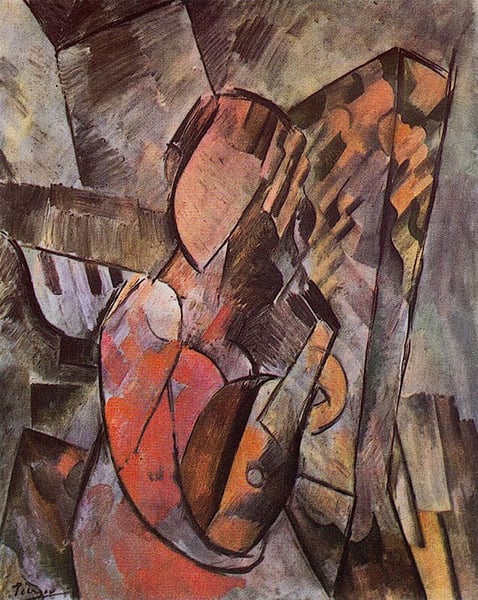
Analisi esperta di Woman with mandolin di Pablo Picasso
Stile: Analytical Cubism · Genere: genre painting
Expert Analysis: Woman with Mandolin by Pablo Picasso
Stylistic & Historical Significance
Pablo Picasso’s Woman with Mandolin (c. 1909–1910) stands at a pivotal crossroads between two defining phases of his career: his African Period (1907–1909) and the full emergence of Analytical Cubism (1909–1912). Although the provided facts list the style as Analytical Cubism and the period as African Period, the painting is most accurately understood as a transitional masterpiece that synthesizes both. This work demonstrates how Picasso transformed the simplified, mask-like forms and angular volumes borrowed from African tribal art into the intellectual, multi-perspective space of Cubism.
Genre & Subject
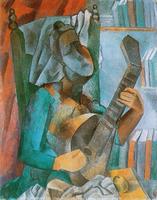
As a genre painting depicting a seated woman with a mandolin, the work conforms to a traditional theme—music and femininity—yet subverts every convention of representation. The mandolin, a recurring symbol in Cubist art, serves as both a recognizable object and a structural device. Its curved body and neck are broken into geometric facets that interlock with the figure’s torso, blurring the boundary between sitter and instrument. This merging of forms prefigures the Cubist concept of “simultaneity,” where objects and space are treated as equal compositional elements.
Analytical Cubism in Action
The canvas exemplifies Analytical Cubism’s core methods:
- Faceting: The woman’s face, seen in multiple angles (frontal and profile simultaneously), is fractured into interlocking planes. Her left eye appears partially in profile, while her right side suggests a three-quarter view—a direct challenge to single-point perspective.
- Monochromatic palette: Hues of brown, gray, and ochre deliberately de-emphasize color, forcing the viewer to focus on structure, line, and the interplay of light and shadow.
- Shallow, ambiguous space: The background collapses into the figure; there is no clear foreground or background. The mandolin’s sound hole becomes a geometric cutout that could be part of the woman’s chest or the surrounding space.
African Period Legacy
Though primarily Analytical Cubist, the painting retains echoes of Picasso’s African Period:
- Simplified, mask-like features: The woman’s eyes are heavy-lidded and asymmetrical, reminiscent of Fang masks or Dan sculptures that Picasso studied at the Musée d’Ethnographie du Trocadéro.
- Rounded, sculptural volumes: The arms and mandolin curve with a weighted, primordial energy, contrasting with the sharper facets of later Cubism.
- Expressive distortion: The elongation of the neck and the disproportionate hand plucking the strings derive from African figural art’s emphasis on spiritual or symbolic proportions over naturalism.
Significance in Art History
Woman with Mandolin is significant because it marks the moment when Picasso fully intellectualized the primal power of African art. Instead of merely copying tribal forms (as in his 1907 Les Demoiselles d’Avignon), he deconstructed them into a new analytic language. This painting directly paved the way for the hermetic, near-abstract works of high Analytical Cubism (1911–1912), such as Ma Jolie or The Accordionist. It demonstrates that Picasso could take a traditional musical genre scene and transform it into a visual argument about perception, reality, and the limits of representation.
Conclusion
Woman with Mandolin is not just a painting of a woman with a musical instrument—it is a manifesto of perceptual revolution. By fusing the tactile, ritualistic energy of African sculpture with the rigorous deconstruction of Cubism, Picasso created a work that challenges viewers to see the world not as fixed but as fragmented, simultaneous, and endlessly interpretable. It remains a cornerstone of early modernism, illustrating how cross-cultural borrowing can spark entirely new visual languages.
Genere
Stile
Visivamente simili
20 opere con composizione e palette affini
Girl with mandolin (Fanny Tellier)
Pablo Picasso
Woman with a mandolin
Jean Metzinger
Clam Diggers
Karl Knaths
El Laudista
Maria Blanchard
Sadness of Young Women
George Stefanescu
Mujer Y Mandolina
Antonia Eiriz
Woman with a Mandolin
Pablo Picasso
Guitar, Glass and Fruit Dish with Fruit
Pablo Picasso
Woman with a Mandolin (after Corot)
Juan Gris
ECSTASY
Yervand Kochar
Woman with Guitar
Aristarkh Lentulov
Musical Instruments
Georges Braque
Pierrot Playing Guitar
Juan Gris
The serenade
Pablo Picasso
The Musician
Paul Guiragossian
Scheiber Hugó, Táncosnő Gitárral
Scheiber Hugó
The Concert
Gino Severini
Scheiber Hugó, Bárban, ,.
Scheiber Hugó
Seated figure
Lyubov Popova
Life of instruments
Amadeo de Souza-Cardoso