
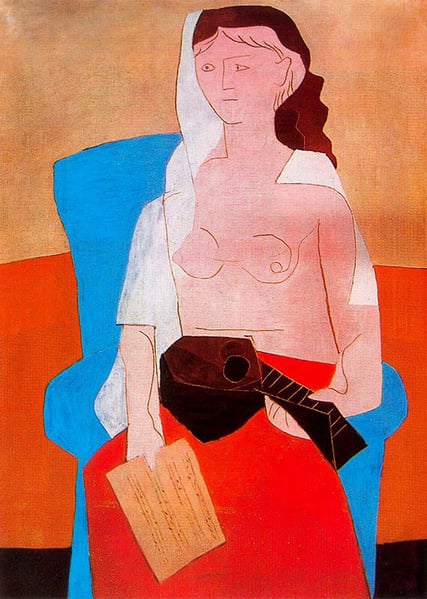
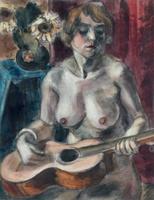
Woman with mandolin
Details
Expert analysis of Pablo Picasso’s Woman with mandolin
Style: Cubism · Genre: genre painting
Expert Analysis: "Woman with Mandolin" by Pablo Picasso
This work sits at a fascinating intersection of Cubist innovation and Picasso's broader stylistic evolution during his Neoclassicist & Surrealist Period. As a genre painting—a depiction of everyday life—it transforms a familiar subject (a woman with a mandolin) into a rigorous formal experiment.
Significance within Cubism:
The painting exemplifies Cubism’s core mission: to fracture three-dimensional reality into overlapping, faceted planes. The mandolin and figure are not seen from a single viewpoint but are reassembled like a puzzle, with the instrument’s curves broken into geometric shards and the woman’s body reduced to angular slabs of color. This approach denies illusionistic depth, instead making the canvas surface the primary reality. The genre setting (a musician in a domestic interior) is deliberately ordinary—Picasso uses it to show that even the most familiar subject can be radically reimagined through the Cubist lens.
Significance within the Neoclassicist & Surrealist Period:
Although the work is Cubist in execution, its placement in Picasso’s Neoclassicist and Surrealist phases is revealing. The Neoclassicist influence appears in the stately, almost sculptural solidity of the figure’s core—a hint of Picasso’s return to figurative order after the extreme abstraction of Analytic Cubism. Meanwhile, the Surrealist undercurrent emerges in the disquieting fragmentation: the woman’s face is split into two profiles, the mandolin hovers as a sharp, alien shape. This duality anticipates Surrealism’s fascination with the uncanny, where a familiar object (mandolin) and subject (woman) become strange through ambiguity.
What makes it significant:
"Woman with Mandolin" is a pivotal work because it demonstrates Picasso’s ability to compress multiple artistic languages into one canvas. It is simultaneously a pure Cubist exercise in multiple perspectives, a nod to classical monumentality, and a premonition of Surrealist dream logic. The genre painting format—typically used for anecdotal or sentimental scenes—is here weaponized to challenge the very act of seeing, proving that modernism could reinvent even the most traditional of subjects. This work stands as a bridge between the intellectual rigor of Cubism and the psychological depth of Surrealism, marking a moment when Picasso’s restless genius refused to settle into a single style.
Museum / Gallery
Visually similar
20 works with related composition and palette
Woman with a mandolin
Jean Metzinger
Nude with Guitar
Theodor Pallady
Still life with antique bust
Pablo Picasso
Woman with fish
Aleksandra Ekster
Fital Lány Mandolinnal
Bela Kadar
Odalisque, Half-Length (The Tatoo)
Henri Matisse
Frauenakt
Gustave Buchet
The serenade
Pablo Picasso
Woman with Guitar
Aristarkh Lentulov
Muzsikálok
Bela Kadar
Art Deco Akt
Bela Kadar
Woman
Jean David
Abstract with Instruments
Louis Schanker
Reading
Pablo Picasso
A dream
Pablo Picasso
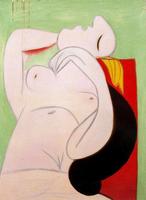
Sleep
Pablo Picasso
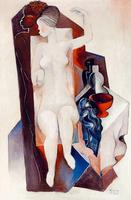
Kompozició
Bela Kadar
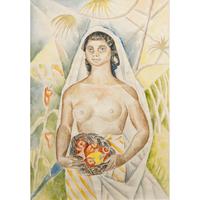
Black woman with peppers
Marevna (Marie Vorobieff)
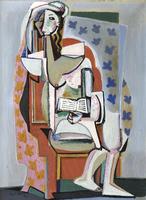
Žena v křesle s knihou
Emil Filla
MODELE A LA GUITARE
Henri Le Fauconnier