
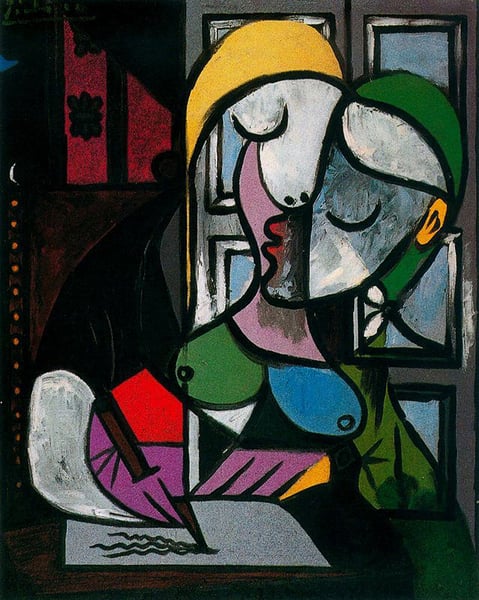
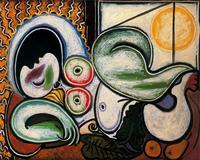
Woman writing
Ayrıntılar
Pablo Picasso sanatçısının Woman writing eseri hakkında uzman analizi
Tarz: Surrealism · Tür: genre painting
Expert Analysis: "Woman Writing" by Pablo Picasso
In this work from Picasso’s combined Neoclassicist & Surrealist Period, Woman Writing exemplifies the artist’s unique ability to weave two seemingly opposing stylistic currents into a single, potent image. The painting operates as a genre scene—an intimate, everyday moment of a woman engaged in the act of writing—yet it is transformed by the Surrealist lens into something both familiar and enigmatic.
Significance within Surrealism and the Neoclassicist & Surrealist Period
Picasso’s surrealist output is often distinguished by his refusal to abandon figuration entirely; instead, he distorts and recontextualizes the human form. Here, the woman’s body likely retains the volumetric, sculptural solidity characteristic of his earlier neoclassical phase (influenced by Ingres and classical relief sculpture), while her pose or facial features are subjected to the irrational, dreamlike manipulations of Surrealism. This duality is central to the work’s significance: it bridges the structured, timeless order of neoclassicism with the automatic, subconscious logic of surrealism, creating a tension between reason and reverie.
The act of writing itself is a motif ripe for surrealist interpretation. Writing implies language, communication, and conscious thought, yet in Picasso’s hands, the woman’s hand or the paper may be rendered in impossible proportions or ambiguous space. The line between the mundane and the mysterious blurs—she may be writing a letter, a poem, or an automatic text channeled from the unconscious. This ambiguity is precisely what makes the work notable: it takes a quotidian genre scene and imbues it with psychological depth, questioning the boundary between waking life and the inner dreamscape.
Artistic Context
During the early 1930s, Picasso moved fluidly between neoclassical order and surrealist experimentation. Woman Writing stands as a testament to his refusal to be confined to a single style. The work likely features a muted, earth-toned palette (echoing neoclassical restraint) with unexpected angular or curved distortions (surrealist invention). The woman’s gaze may be averted, absorbed in her task, yet her hands or the writing instrument may appear disjointed, suggesting a split between the physical and mental acts of creation.
In sum, Woman Writing is significant as a synthesis: it demonstrates that Surrealism need not abandon the human figure, and that Neoclassicism can be infused with subterranean emotion. Picasso’s ability to fuse these periods into a coherent, haunting image marks this work as a key example of his mature practice—where the everyday becomes a doorway to the extraordinary.
Görsel olarak benzer
İlişkili kompozisyon ve renk paletine sahip 20 eser
Girl in front of mirror
Pablo Picasso
Seated woman
Pablo Picasso
Two figures
Pablo Picasso
Seated woman (Jacqueline)
Pablo Picasso
Portrait of woman
Pablo Picasso
The student
Pablo Picasso
Seated woman
Pablo Picasso
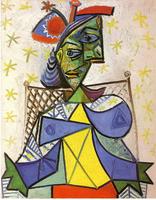
Seated woman with blue and red hat
Pablo Picasso
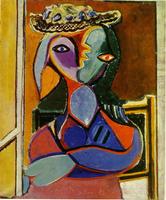
Untitled
Pablo Picasso
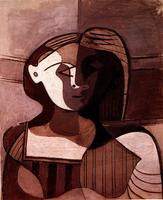
Buste of young woman (Marie-Therese Walter)
Pablo Picasso
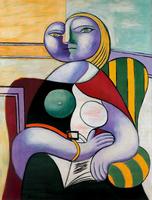
Reading
Pablo Picasso
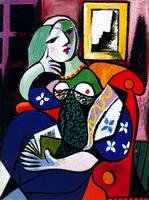
Woman with book
Pablo Picasso
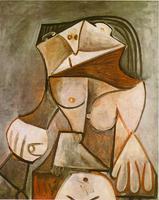
Crouching female nude
Pablo Picasso
Untitled
Pablo Picasso
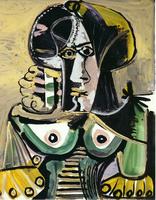
Bust of woman
Pablo Picasso
Untitled
Pablo Picasso
Woman turned right
Pablo Picasso
Breakfast
Pablo Picasso
Lovers (The kiss)
Ernst Ludwig Kirchner
Lying female nude
Pablo Picasso