
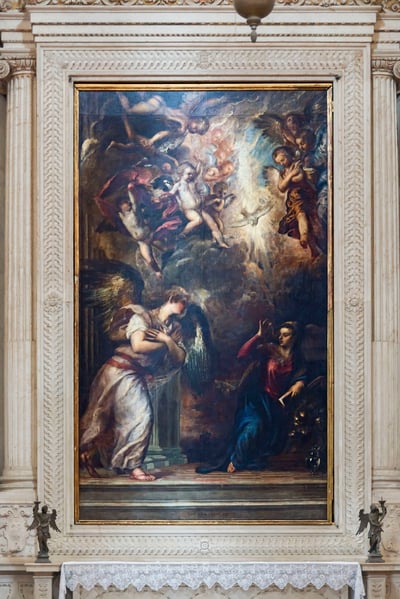
Analisi esperta di Annunciation di Titian
Stile: Mannerism (Late Renaissance) · Genere: religious painting
The "Annunciation" by Titian represents a mature, Mannerist interpretation of a traditional religious subject, placing it at the nexus of Late Renaissance innovation and the emerging stylistic concerns of Mannerism. While Titian is most famous for his Venetian High Renaissance colorito and naturalism, this late work—painted when Mannerism was taking hold across Italy—demonstrates his deliberate engagement with that style’s characteristic tension, elegance, and emotional complexity.
Significance within Mannerism (Late Renaissance):
Mannerism is defined by its departure from the balanced harmony of the High Renaissance, favoring instead compositional instability, exaggerated poses, and heightened drama. In this Annunciation, Titian achieves this through several key means:
-
Restless Composition: The angel Gabriel does not float serenely but bursts into the space with a dynamic, almost spiraling motion. Mary’s figure, in contrast, is often depicted recoiling or twisting in a pronounced figura serpentinata, her elongated body reflecting Mannerist idealization rather than natural proportion. This asymmetry and diagonal thrust create a charged, unsettled atmosphere.
-
Emotional Intensification: The moment of divine revelation is rendered with palpable psychological tension. Mary’s expression—often a mix of awe, humility, and alarm—amplifies the spiritual mystery. Titian’s use of dramatic chiaroscuro and flickering light (a precursor to tenebrism) isolates the figures against a dark, ambiguous background, emphasizing their spiritual isolation and the miraculous nature of the event.
-
Lush, Mannerist Color: Even within Mannerism’s penchant for artificial or acidic hues, Titian’s Venetian roots shine through in the rich, glowing palette—deep crimson, lapis lazuli blue, and golden light. This coloration, applied with his notoriously free, painterly brushwork (especially in the drapery and the dove of the Holy Spirit), creates a shimmering surface that is both sensuous and transcendent.
Religious and Stylistic Significance:
As a religious painting, Titian’s Annunciation goes beyond mere narrative. The Mannerist distortions—the elongated fingers, the skewed perspective, the unsettling spatial ambiguity—serve to convey the incomprehensible supernatural. The work refuses the calm clarity of earlier Annunziate; instead, it pushes the viewer into the subjective experience of the sacred, a hallmark of Counter-Reformation spirituality that Mannerism often anticipated.
In short, this painting is significant because it shows a master of the High Renaissance boldly adapting Mannerist conventions—asymmetry, emotional exaggeration, and artificial elegance—to revitalize a canonical biblical theme. The result is an Annunciation that feels both historically pivotal and intimately, unsettlingly present.
Museum / Gallery
Visivamente simili
20 opere con composizione e palette affini
Transfiguration of Christ
Paolo Veronese
Madonna Col Bambino, San Benedetto E Altri Santi
Palma il Giovane
Virgin and Child with Saints
Paolo Veronese
Natività Di Maria
Palma il Giovane
Madonna in Trono E Santi
Palma Vecchio
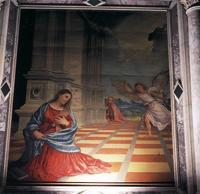
The Annunciation
Titian
San Domenico raccoglie le rose per la Madonna del rosario
Palma il Giovane
Discesa al limbo
Alessandro Allori
The Madonna of the Pesaro Family
Titian
The Miracle of St Agnes
Tintoretto
Pietà
Palma il Giovane
Madonna della Scodella
Correggio
Sacred Conversation
Francesco Solimena
Deposition
Francesco de' Rossi (Francesco Salviati), "Cecchino"
Saint Bartholomew
Angelo Inganni

Natività Di Maria (detail)
Palma il Giovane
St. Benedict welcomes his disciples, Maurus and Placidus
Palma il Giovane
Basilica Di Santa Maria Gloriosa Dei Frari, Altare Di Santa Caterina
Palma il Giovane
Chiesa della Consolazione (San Tommaso Di Villanova Distribuisce I Beni Ai Poveri)
Domenico Fiasella
The Annunciation
Bartolome Esteban Murillo